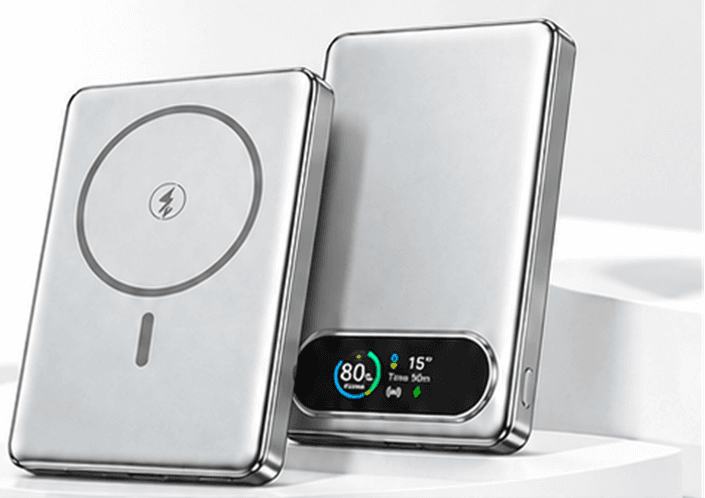
Introduction
Semi-solid-state battery technology can attract attention in a power bank range, but the technology name does not complete a purchasing assessment. Overseas buyers still need to know which cell is inside, how the finished product behaves, what the supporting documents cover, and which claims can be communicated responsibly.
This matters because several different questions are often combined in one marketing statement. Battery construction, charging speed, cycle life, product safety, and shipping arrangements are related to the product, but they are not interchangeable evidence. A promising description of one feature cannot establish all the others.
This guide gives accessory brands, importers, and distributors a practical framework for comparing semi-solid-state and conventional lithium-ion power banks. It does not report a completed ZONNGOO laboratory evaluation or claim that a particular battery construction eliminates risk.
Quick answer: Verify the actual cell, the finished power-bank configuration, relevant test methods and reports, cycle-life conditions, and production traceability. A semi-solid-state label alone does not prove fire immunity, a particular service life, faster charging, or an exemption from battery transport requirements.
1. Understand the terminology before comparing products
“Lithium-ion” and “semi-solid-state” do not necessarily describe mutually exclusive categories. Lithium-ion refers to a broader battery technology family, while semi-solid-state language commonly concerns aspects of the electrolyte or internal construction. A product described as semi-solid-state may still be a lithium-ion battery product.
Conventional lithium-ion cells often use a liquid electrolyte. Semi-solid descriptions may refer to gel-like or mixed systems, but supplier terminology is not a universal specification. Ask what the manufacturer means rather than assuming a defined liquid percentage or a particular material from the label.
All-solid-state and semi-solid-state are also different descriptions. The US Department of Energy's discussion of next-generation batteries provides broader context for changing battery materials. It does not certify a commercial power bank or establish the composition of a supplier's cell.
For a purchasing comparison, request a concise technical explanation linked to the exact cell model. A generic cross-section illustration may help explain a concept, but it is not evidence that the product contains that construction. Identify which information is a technology overview and which is a verified product attribute.
2. Separate potential benefits from verified benefits
Research into alternative electrolytes and battery construction can identify useful performance possibilities. Turning a possibility into a commercial product claim requires evidence for the actual materials, cell, and finished product. Results from another chemistry or laboratory prototype should not be copied onto a retail specification.
| Proposed benefit | Evidence a buyer should request |
|---|---|
| Improved safety behaviour | Defined tests, sample identity, conditions, results, and scope |
| Longer cycle life | Cycling method, temperature, end-of-life criterion, and retained capacity |
| Higher energy density | Energy and mass or volume measured at the same product boundary |
| Faster charging | Supported profiles, receiving devices, input conditions, and measurements |
| Better low-temperature operation | Defined temperature conditions and actual product results |
| Easier shipment | Applicable transport documentation and route-specific logistics review |
For every comparative statement, ask: better than what, under which conditions, and measured how? “Safer battery” is incomplete without a comparison and a defined basis. A product can perform well in one test without establishing superiority in every real-world condition.
This approach does not dismiss a new technology. It creates a fair way to evaluate it. A well-supported semi-solid-state product should be assessed on its evidence, just as a conventional lithium-ion product should be assessed on its own design and documentation.
3. Ask the supplier to identify the actual cell
Begin with the cell manufacturer, model, nominal voltage, capacity, and current datasheet revision. Ask how the cell is identified within the finished power bank and how the supplier can connect production batches with the approved configuration.
Request an explanation of any composition claim used in the marketing. If a percentage is quoted, ask what it measures and how it was determined. Percent by mass, volume, or another basis can mean different things. An unexplained percentage is not a complete technical description.
Manufacturers may legitimately protect proprietary formulation details. That does not remove the need to identify the supplied component and provide enough reliable information to assess the proposed commercial claims. Discuss what can be disclosed and which independent evidence can support information that remains confidential.
Clarify the change-control process. If the cell is substituted, who approves the replacement and who reviews the impact on performance, labels, reports, and shipment documentation? A similar size or capacity does not automatically make a different cell interchangeable for every purpose.
4. Review safety at cell and finished-product level
The cell is part of a system. A power bank also includes charging and protection electronics, interconnections, a wireless charging assembly where fitted, an enclosure, and controls. The complete design influences how the product operates and responds to foreseeable conditions.
Ask what evaluation covers the cell and what covers the finished power bank. UL's UL 2056 overview describes electrical, mechanical, and other aspects of power-bank testing. A reference to this standard is not proof that a particular product has been evaluated or certified; review its actual documentation.
What a demonstration can establish
A puncture demonstration or abuse-test video may show the behaviour of a specific sample under recorded conditions. To interpret it, you need the sample identity, state of charge, method, environment, observations, and the report's scope. An edited video without those details offers limited purchasing evidence.
What it cannot establish
One demonstration cannot prove that a product can never ignite, fail, or be damaged under any condition. Do not transform “no ignition observed in this defined test” into “fireproof.” Have hazardous testing performed by a qualified facility; it is not an appropriate informal buyer-side experiment.
5. Read cycle-life claims as test results
A claim such as “800 cycles” is incomplete without an end-of-life criterion. Did the test stop when retained capacity fell below a defined percentage? Was the measurement made on the cell or the finished pack? What charging and discharging conditions were used?
Request temperature, charge and discharge rates, voltage limits, rest periods where relevant, sample count, and the method used to measure capacity. These details influence what a cycling result means. Two reports with the same cycle count may describe very different performance.
Calendar aging and cycling are also different. A laboratory cycling result does not automatically establish how many years a customer will use the product, and it does not define the commercial warranty. Keep service-life expectations and contractual warranty terms separate in your buyer documentation.
For context, published research such as this study of a gel electrolyte system investigates a particular experimental configuration. Its findings cannot be assigned to a ZONNGOO power bank without evidence connecting the commercial product to the tested system and conditions.
6. Assess charging performance independently
Battery construction does not establish the USB-C charging profiles or wireless compatibility of the finished power bank. Charging performance depends on the whole system and its operating limits, including the receiving device and charging interface.
Separate four questions during evaluation: how much nominal energy is stored, what input and output modes are supported, what performance has been measured, and what certification applies. A positive answer to one does not answer the others.
For a wired claim, request the voltage and current profiles, required adapter and cable, and any shared-output limits. For wireless operation, request the intended devices, alignment conditions, and method used to substantiate the advertised output. Display graphics and magnetic attachment do not establish certified performance.
If a wireless certification is important to the buying brief, verify the exact model in the Wireless Power Consortium product database. Confirm that the identity corresponds to the proposed order configuration rather than a visually similar product.
7. Compare energy density and portability on equal terms
Energy density can be discussed at material, cell, battery-pack, or complete-product level. These boundaries are different. A cell-level figure should not be compared directly with the mass of a finished power bank that includes its enclosure, electronics, coil, magnets, and display.
When evaluating a portable product, request nominal energy in watt-hours, net product mass, and overall dimensions. If a supplier presents watt-hours per kilogram or per litre, confirm the measurement boundary and the values used to calculate it. Maintain the same boundary across the comparison.
Thinness and light weight are useful only in the context of the intended application. Evaluate camera clearance, handling on representative phones, port access, and the combination of the phone and power bank. A thin profile alone is not evidence of superior safety or usability.
Document the complete sample configuration. Two products with different capacity, displays, materials, or accessory features may have different weights for reasons unrelated to electrolyte construction. Avoid attributing every physical difference to the technology label.
8. Treat shipping as a separate workstream
A semi-solid-state description does not automatically remove battery transport obligations. Start with the actual product and battery identity, then have the proposed route and mode reviewed by a qualified logistics provider. Do not infer shipping eligibility from a marketing term.
Request the applicable UN 38.3 test summary and check its correspondence with the supplied battery. PHMSA's guidance on test summaries explains their role. The summary should support traceability; it is not a general statement that every shipment arrangement is acceptable.
IATA's battery transport information provides a starting point for air-transport planning. Requirements depend on the actual consignment and current applicable rules. Passenger baggage information should not be reused as a complete commercial cargo instruction.
Build logistics review into installation-free product launches as carefully as you would production planning. Although a power bank does not require site installation, the buyer still needs preparation: correct manuals, packaging, storage information, distributor guidance, and a workable receiving process.
9. Verify production consistency and change control
A strong sample presentation is only the beginning. Ask how the approved cell, electronics, and finished specification are maintained through production. Factory testing records should be connected to the relevant model and batch rather than presented as generic evidence that a facility owns equipment.
Agree on traceability expectations and the records available for shipment inspection. Useful information can include the order reference, product revision, batch or carton identifiers, quantities, and findings from the agreed checks. The level of detail should match the risks and the commercial agreement.
Define which changes require notice before shipment. A substitution that appears commercially minor may change performance or document applicability. Identify who reviews the change and what evidence is required before the revised product can be accepted.
For repeat orders, compare the new proposal against the approved baseline. Component availability and manufacturing arrangements can change over time. A written revision and approval process gives both parties a way to handle those changes without relying on memory or assumptions.
10. Translate evidence into accurate marketing
The best customer-facing explanation connects a specific product feature with evidence that can be reviewed. Avoid blanket statements such as “cannot catch fire,” “never explodes,” “zero risk,” or “certified for every market.” These statements extend beyond what a technology name or a limited test can establish.
If a test supports a narrower statement, preserve its conditions and scope. Identify whether a result concerns a cell sample, a finished product sample, or an ongoing production control. Do not imply that a single evaluation individually tested every unit in a later shipment.
The same discipline applies to patents and insurance. A patent concerns an intellectual-property right; it is not a product safety certificate or a performance test. Insurance coverage also needs its own policy scope and current evidence before it becomes a meaningful customer-facing claim.
Prepare an internal claims register linking each proposed statement to a specification, report, or other appropriate evidence. Include the limitations and an owner responsible for keeping it current. This gives sales, website content, packaging, and customer support a common reference.
11. Make the comparison a staged buying decision
Start with technical identity and the intended application. If the supplier cannot identify the proposed cell or explain the commercial claim, resolve that issue before investing in detailed artwork. Next, evaluate samples and relevant documents, then approve the complete branded configuration.
Use a written review to separate accepted evidence from open questions. A report awaiting clarification should remain an open item rather than being described as approved. Assign owners for document review, sample evaluation, logistics, and customer communication so that no one assumes another team has completed the check.
A well-documented conventional lithium-ion product may be a stronger sourcing option than a poorly documented product carrying a newer technology label. The reverse can also be true when the new product has appropriate evidence and fits the application. The objective is a supportable purchasing decision, not a preference for terminology.
Frequently asked questions
Can a semi-solid-state battery still be lithium-ion?
Yes. The descriptions can refer to different aspects of a battery. Ask the manufacturer to explain the exact chemistry and construction of the supplied cell rather than treating the terms as automatic opposites.
Are semi-solid-state power banks automatically safer?
No blanket conclusion follows from the label. Safety assessment needs evidence for the actual cell, finished design, operating conditions, and relevant tests. Review comparative claims on a defined basis.
Does passing a puncture test prove that a product is fireproof?
No. It describes an outcome for a defined sample and procedure. It does not establish immunity to every failure mode or operating condition. Use the test's actual scope when communicating the result.
What information should support an 800-cycle claim?
Request the test method, temperature, charging and discharging conditions, sample identity, end-of-life capacity criterion, and whether the result concerns the cell or the finished product. A cycle number without those details is difficult to interpret.
Do patents prove the power bank's safety performance?
No. Patent evidence and product testing serve different purposes. Verify patent ownership and scope separately from any safety evaluation, performance measurement, or certification claim.
What should I request when evaluating ZONNGOO WiMag 10MC9?
Ask for the current product specification, confirmed cell and model identity, supported charging modes, and relevant model-specific documentation available for review. Do not assume that every statement in older promotional material applies to your proposed order configuration.
Conclusion
Semi-solid-state technology is a topic worth evaluating with precise questions. Establish the actual product identity, distinguish potential benefits from measured results, assess the finished system, and connect commercial claims with appropriate evidence. This approach supports clearer procurement decisions and more credible customer communication across your website, packaging, and sales process.
Evaluating a semi-solid-state magnetic power bank for your market? Send ZONNGOO your application and documentation requirements. Include your destination market, estimated quantity, intended devices, and the evidence your team needs to review before sample and order approval.