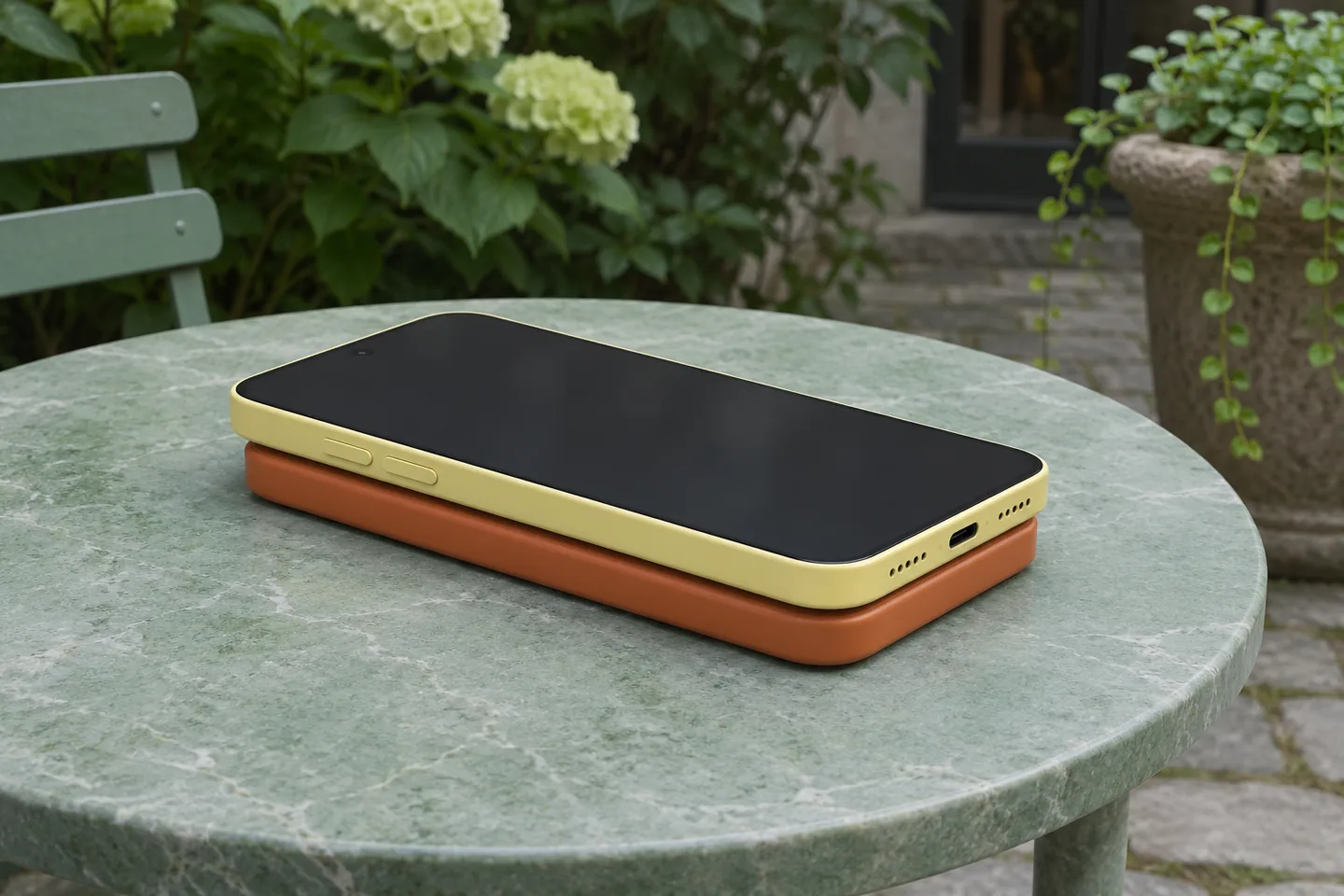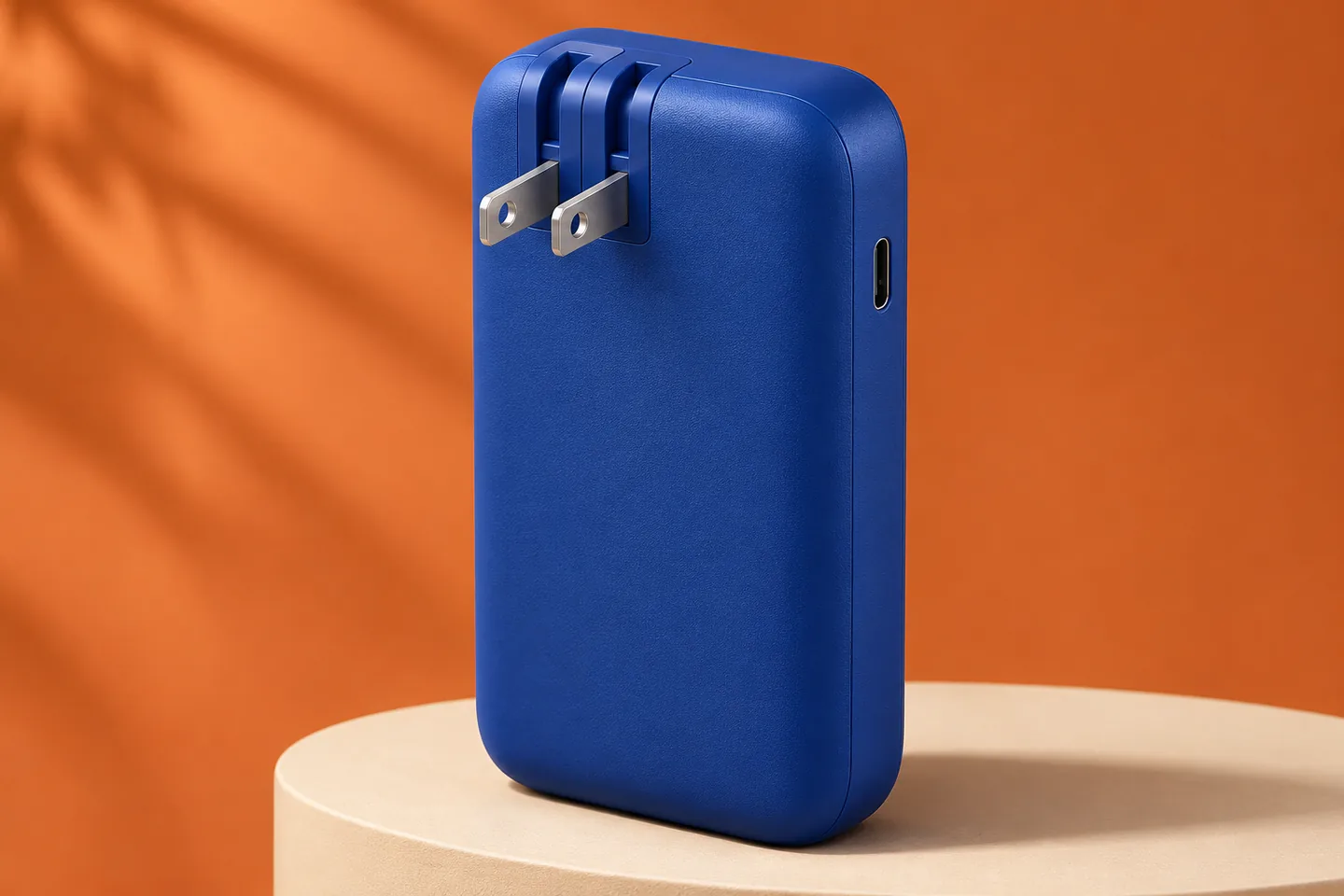
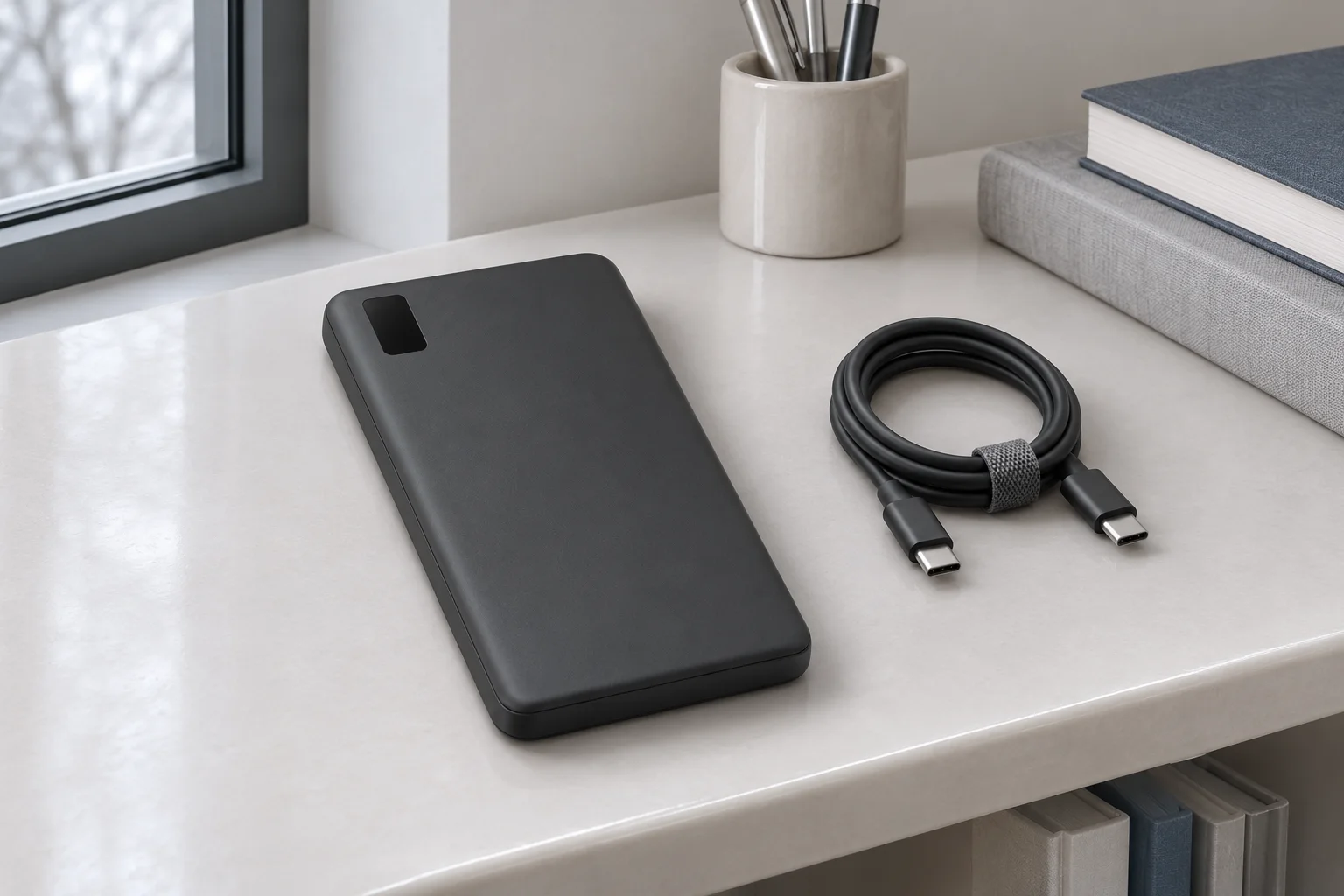
Quick answer
Store an unused power bank unplugged in a dry place protected from heat, direct sunlight, moisture and physical damage. Follow the instructions for the exact model, including any recommended storage charge level and checking interval. Do not deliberately leave it empty for months or assume that keeping it permanently connected is the right way to preserve it. Inspect its condition before returning it to service.
There is no single storage percentage or maintenance schedule that should be copied onto every power bank. Battery construction, electronics and the manufacturer's instructions matter. For a ZONNGOO product, identify the complete model and battery series and request the applicable guidance. This article provides a practical care and record-keeping framework, not a model-specific storage specification, a repair procedure or evidence that any battery technology eliminates the need for careful handling.
Introduction
A power bank may spend weeks in a desk, a spare bag or an unopened gift box before it is needed again. The important question is not simply whether some charge remains. Where was it kept? Was it connected to another device? Has the housing or cable changed condition? Are the instructions still available? Answering those questions is more useful than treating a battery indicator as a complete health report.
For households, the aim is an uncomplicated routine that follows the product instructions. For retailers and corporate buyers, the same concern also affects sample cabinets, gift stock and support information. Commercial stock storage may require additional controls beyond personal-use advice. The sections below distinguish these situations and explain what to ask the supplier without inventing a universal shelf life or promising a fixed number of years of service.
1. Start with the exact model instructions
Keep the product reference and its instructions together. ZONNGOO distinguishes all-solid-state, semi-solid-state lithium and lithium-polymer product categories, sometimes with similar-looking housings or related model names. Do not transfer a storage statement from one configuration to another because the products look alike. Ask for confirmation when the model suffix, battery series or supplied document differs.
Look separately for operating, charging and storage conditions. They are not necessarily the same limits. If a specification gives only an operating range, do not present that as permission for extended storage throughout that range. For an enquiry, describe the intended duration and environment and ask which instruction applies. A catalog image or a marketing claim is not a replacement for the appropriate user guidance.
2. Choose the location before putting it away
Select a place where the product will not be exposed to avoidable temperature extremes, moisture or pressure from other objects. A location convenient for a cable is not automatically suitable for unattended long-term storage. Think about how the environment changes during the day, including sunlight moving across a desk or heat building inside a parked vehicle.
Health Canada's lithium-ion battery guidance recommends room-temperature, dry storage and cautions against leaving batteries in sunlight or hot or cold cars. It also emphasizes keeping them away from children. These are general care principles, not confirmation of the storage limits for every ZONNGOO battery-series variant. Obtain the exact limits from the product information rather than guessing from its exterior materials.
3. Distinguish short pauses from extended storage
Putting a power bank aside until tomorrow is different from leaving it unused for a season. For a short pause, disconnect the charging setup as instructed and place the undamaged product appropriately. For an extended period, review the model's guidance on charge level and periodic checking before you put it out of sight. Do not wait until the next trip to discover that the instructions are missing.
| Situation | What to review | What not to assume |
|---|---|---|
| Between ordinary uses | Disconnection, location and visible condition | An indicator alone proves health |
| Unused for an extended period | Model-specific charge and checking guidance | Every model uses the same percentage |
| Retail or corporate stock | Supplier instructions and stock-management plan | Personal-use advice is a complete warehouse procedure |
The table is a decision aid. It does not establish a universal duration threshold, storage limit or inspection frequency.
4. Ask about storage charge instead of guessing
Some manufacturers recommend a partial charge for extended storage of their products. For example, Apple's battery performance guidance discusses half-charged storage for its devices and explains why prolonged empty or full storage can be undesirable. That is Apple guidance for the equipment it covers, not an automatic instruction to set every third-party power bank to exactly the same percentage.
For your selected product, request the recommended range and what to do if the indicator is approximate. Do not deliberately cycle the device repeatedly just to hit a cosmetic number. Also avoid inventing a self-discharge rate from the capacity label. A useful supplier answer identifies the model, charge guidance, checking interval and any conditions that affect the recommendation. Keep that answer with the product reference for later use.
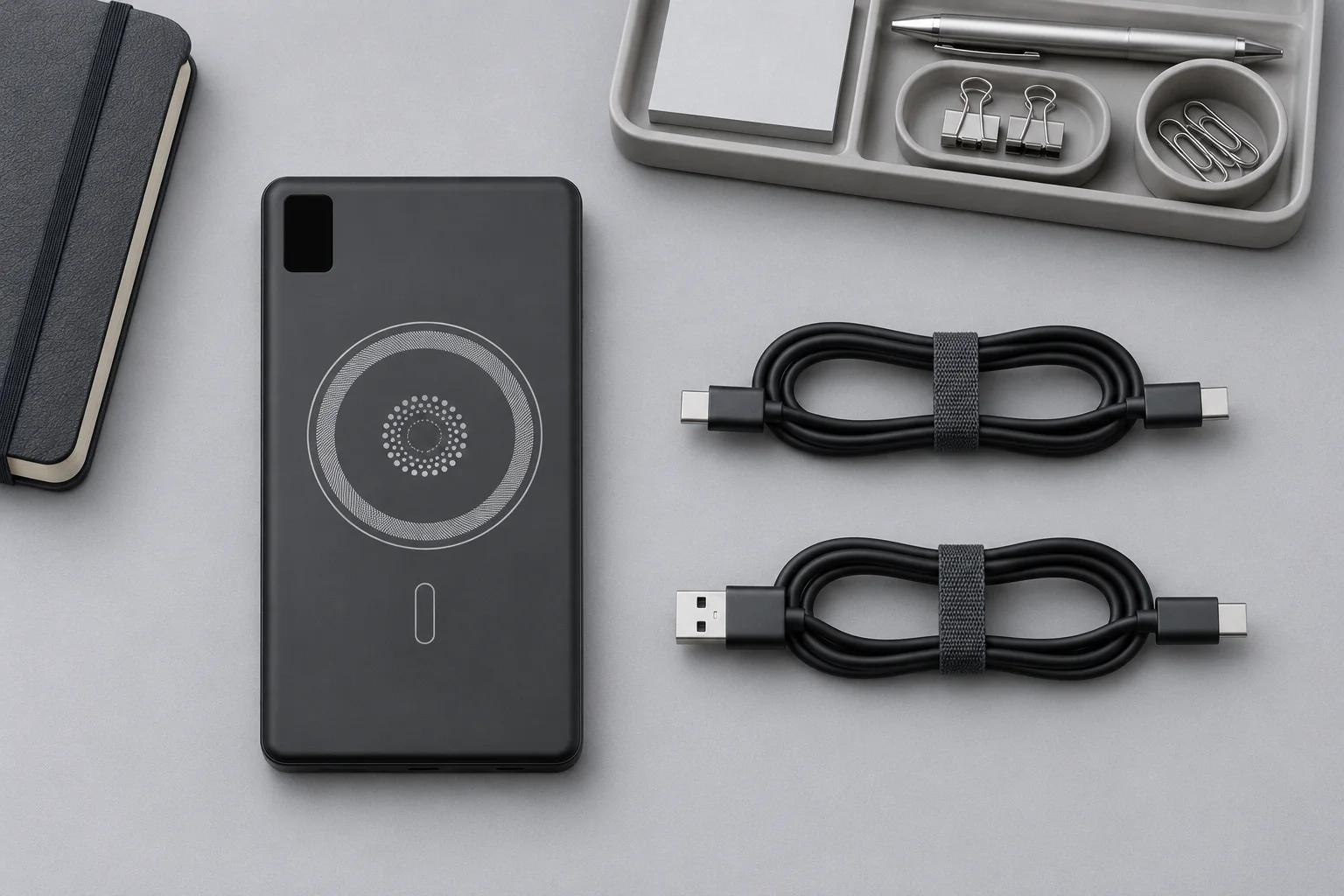
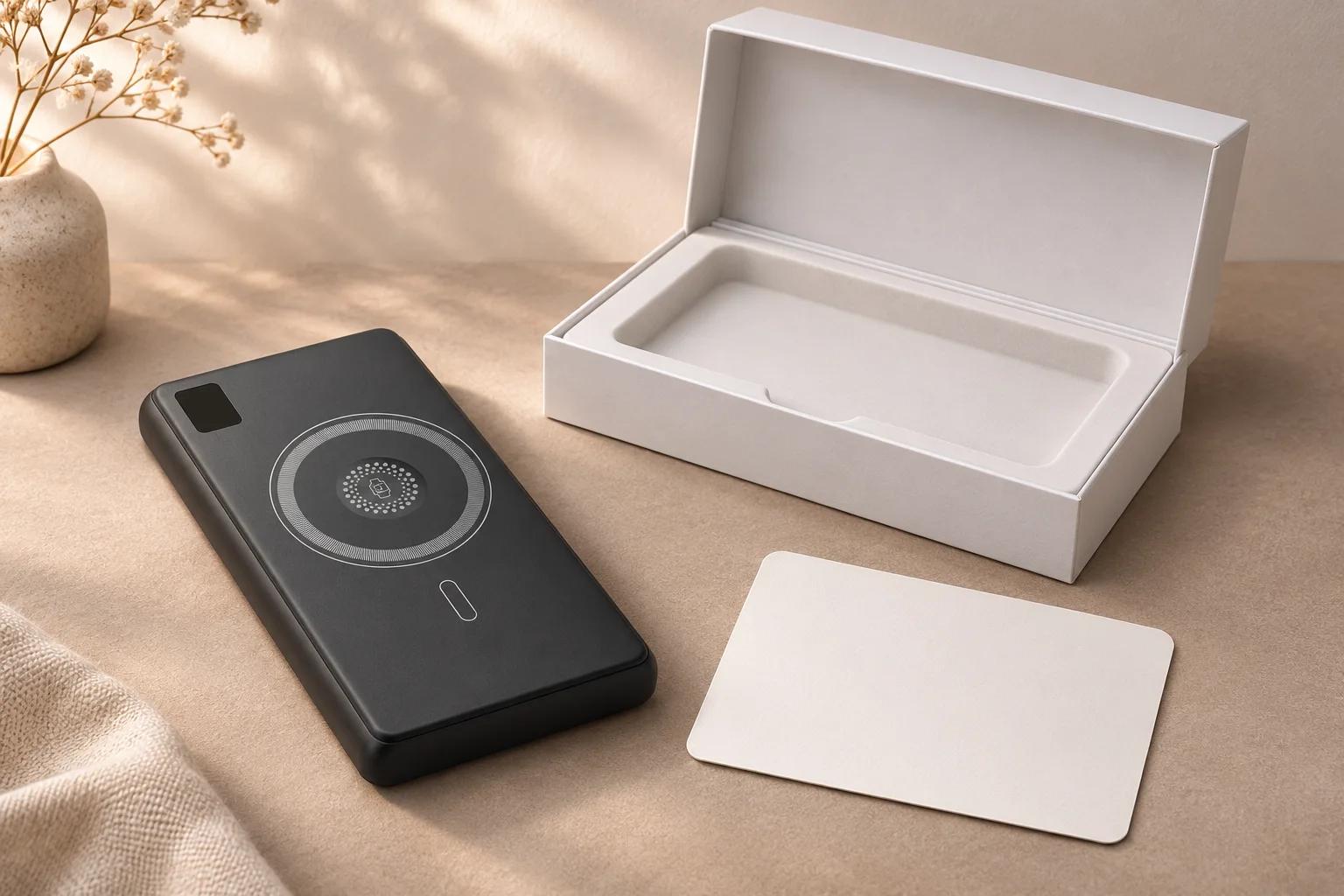
AI-generated care illustration; not a photograph of a storage test or proof of a model's charge-retention performance.
5. Disconnect accessories and prevent accidental loading
Before putting the device away, follow its instructions to end charging and disconnect phones, cables and other loads. Do not assume a connected accessory draws nothing because its screen is dark. An unused power bank is easier to identify and review when its connections are not hidden inside a bag or mixed with another charging setup.
Keep detachable cables organized separately so they are not pulled, pinched or wrapped tightly around the product. If cables are built in, use the intended storage arrangement without sharp bending or forcing a connector into an unsuitable recess. This is ordinary handling advice, not a claim that all cables have the same construction or durability. Inspect the actual cable and request the relevant instructions when its storage method is unclear.
6. Avoid physical damage while it is stored
Choose an arrangement that does not place heavy objects on the device or allow it to fall whenever a drawer is opened. Keep the housing and ports accessible enough to notice obvious changes. Do not use a tightly packed travel bag as a substitute for a considered storage location, and do not treat a decorative box as proof that pressure or impact cannot reach the product.
The goal is to avoid damage, not to improvise an enclosure claimed to make any battery safe. A pouch, insert or original package should be used only as appropriate under the product's instructions and its condition. Never put a damaged device back into ordinary stored stock simply because it still fits the box. Damaged-product handling needs separate manufacturer or qualified local guidance.
7. Make periodic checking a simple reminder
Use the manufacturer's recommended interval rather than a universal calendar copied from another brand. Record the date you put the product away, the model reference and when the next check is due. For personal use, a small reminder can be sufficient. For several units, a basic list helps distinguish an overlooked item from one recently reviewed.
At a check, review visible condition and the indicated charge as instructed. If the model requires a maintenance recharge, use an appropriate setup and follow the normal charging instructions rather than leaving it connected indefinitely. Do not assume that more frequent full cycling improves every product. If the expected charge behavior changes, record the observation and ask for advice instead of repeatedly charging and discharging to force a preferred reading.
8. Recognize when ordinary use should stop
Do not return an obviously damaged or suspect product to normal charging simply to see whether it still works. The Queensland Fire Department's battery guidance identifies warning signs such as swelling, cracking, leaking, unusual sounds or smells and advises against charging damaged or hot equipment. Follow the manufacturer's instructions and seek appropriate local assistance for a concerning product.
Do not open, puncture, flatten or attempt to repair a sealed power bank. If there is smoke, fire or immediate danger, move away and contact local emergency services; this article is not an incident-response procedure. For a non-emergency support enquiry, provide the exact model and observations without handling the device in a way that creates further risk. A photograph is useful only when it can be taken without unsafe handling.
AI-generated record-keeping concept; not a real inspection, service record or safety certification.
9. Review the setup before the next charge
When the device is needed again, check the housing, ports and cable condition before reconnecting it. Read any relevant instruction you have forgotten. Confirm that the adapter and cable suit the model's input requirements; the physical fit of a connector is not a complete compatibility check. If the unit was stored in unsuitable conditions or shows unexpected changes, obtain advice before use.
Charge using the prescribed arrangement in a suitable location where you can monitor the product. Do not cover it or place the charging setup on bedding. A low reading after storage does not justify bypassing protection or trying an improvised charging method. For ordinary connection questions, the built-in cable guide explains why connector roles and ratings should be confirmed separately from appearance.
10. Give retail and gift stock its own plan
Retailers and corporate buyers should request storage and maintenance instructions for the actual stock configuration, including any packaging constraints. Keep model and battery series identifiable, maintain receipt dates and define who reviews the units. Do not infer a guaranteed shelf life from nominal capacity, a cycle-life claim or the date printed in an unrelated product presentation.
Distinguish new stock, demonstration units, returned products and items awaiting review. A customer's returned unit should not silently become saleable stock because its indicator lights up. Agree the review and disposition process with the supplier and any applicable local requirements. The retail range planning guide covers product references and replenishment; it does not replace a site-specific commercial battery-storage or fire-safety assessment.
11. Ask for guidance that follows the product
For a ZONNGOO enquiry, provide the complete model, battery series, intended storage duration and environment, quantity and destination market. Ask for applicable instructions, recommended checking and any preparation needed before use. If the question concerns a specific unit, include its purchase reference and a clear description of the issue. Contact info@zonngoopower.com rather than guessing a maintenance procedure from a different product.
Brands preparing customized packaging should make sure care information stays consistent with the approved configuration and language. Use the packaging design page and sample confirmation process to discuss the intended documents and review scope. Do not add universal storage claims to a gift box simply to reduce customer questions. Clear, specific instructions are more useful than broad promises that a product needs no attention.
Frequently asked questions
Should I store every power bank at exactly 50 percent?
No. A partial-charge recommendation for one manufacturer's equipment is not a universal specification. Request the guidance for your exact model and follow it, including how to interpret an approximate indicator.
Can I leave a stored power bank permanently plugged in?
Do not assume that is the correct maintenance method. Follow the product's charging and storage instructions, disconnect as directed and perform any recommended check or recharge using the prescribed arrangement.
Is a car a suitable long-term storage place?
A parked car can expose the product to unsuitable temperatures. Choose a dry, protected location consistent with the model instructions instead of treating a glove compartment or trunk as a controlled environment.
Does a solid-state label mean storage precautions no longer matter?
No. Keep the exact battery-series reference and follow the product instructions. A technology label does not establish immunity to damage or replace model-specific storage and handling information.
What if a stored unit looks swollen or damaged?
Stop ordinary use and do not charge it to test it. Seek manufacturer and appropriate local guidance. Do not open or repair it; if there is immediate danger, move away and contact emergency services.
What should a business ask ZONNGOO before holding stock?
Ask for instructions linked to the model and series, storage conditions, checking guidance, packaging considerations and the process for suspect or returned units. State quantity, location conditions and intended duration so the answer addresses the actual situation.
Conclusion
Good storage is a small routine built around the exact product: a suitable location, disconnected accessories, model-specific charge guidance and a reminder to check condition. Keep care records understandable and stop ordinary use when a unit appears suspect. For commercial stock, add a supplier-confirmed management plan rather than assuming personal-use tips cover every requirement. This helps customers prepare for the next use without unsupported promises about lifespan or absolute safety.