Quick answer
Build a small power bank range around distinct customer jobs, not three products with different colors and nearly identical explanations. A practical starting framework is a compact everyday option, a convenience-focused option and a higher-demand option. Define the intended devices, carrying priorities and charging arrangement for each, then confirm suitable models and commercial terms. Three products are a planning example, not a universal optimum or a promise of better sales.
The purchasing decision should connect a clear shelf message to a verified specification, an approved sample and a manageable replenishment process. Avoid choosing solely by the largest mAh or wattage number. A retail range also needs understandable differences, accurate compatibility language, suitable packaging and a way to handle questions after purchase. This guide explains that assortment decision without inventing demand forecasts, margins or guaranteed performance for ZONNGOO products.
Introduction
A crowded product catalog can make an opening order harder rather than easier. Several attractive power banks may share a similar housing, while their cell capacities, interfaces and battery series differ. Conversely, two visually different products may answer essentially the same customer need. The buyer's task is to turn these options into a range a shopper can understand and a store can support.
Start with the channel and the customer question. A counter display for occasional phone top-ups has different priorities from a specialist electronics listing explaining charging profiles. Neither requires buying every available variation. For ZONNGOO, request the current specifications and availability for the selected references. The approach below is a proposed planning method, not a report of sales results or a claim that every configuration is currently available in stock.
1. Define the customer and selling channel
Write a short brief covering the main devices, intended use and sales environment. For example, decide whether the range serves light daily carrying, cable convenience or buyers with more demanding supported devices. These are customer jobs, not demographic assumptions. Ask what problem the shopper is trying to solve and which trade-off matters most when a salesperson has only a short conversation.
Also consider how the product is explained. In-store packaging needs a clear primary message and readable details. An online listing can provide a comparison table, but it still needs accurate images and limitations. If the same range serves both channels, keep the underlying specification consistent. Do not simplify the shelf copy by introducing a stronger claim than the detailed product page or supporting evidence allows.
2. Give each product one primary role
Assign a primary reason to buy each proposed item before selecting its color or logo. An everyday option might prioritize carrying comfort. A convenience option might address built-in cable access or a useful supported stand arrangement. A higher-demand option might serve devices needing a verified output profile or a larger energy reserve. These roles may overlap, so compare the actual models before deciding all three deserve a place.
| Proposed role | Main customer question | Evidence to obtain |
|---|---|---|
| Everyday carry | Will I comfortably carry and use it? | Dimensions, weight, fit and sample handling |
| Charging convenience | Does the connection arrangement suit my routine? | Connector roles, reach, compatibility and instructions |
| Higher demand | Does it meet my device's charging and energy needs? | Output profiles, capacity basis and operating limits |
If two items need the same sales explanation, remove one or identify a meaningful difference. A smaller initial range can be easier to explain, but it does not automatically reduce commercial risk.
3. Compare capacity on a consistent basis
Record nominal cell capacity, the associated voltage basis and any rated output capacity with its stated conditions. Do not treat a large printed mAh figure as a guaranteed amount delivered to a phone. Conversion and the complete charging system affect what the user receives. Compare the same measurement basis across candidates rather than ranking unlike numbers.
Separate energy reserve from portability. A customer may accept more size for a longer interval between recharges, while another may prefer a lighter product they actually carry. Avoid turning that preference into an assumed number of full phone charges. The capacity comparison guide discusses the distinction in more detail. Ask for the specification of the exact battery-series variant instead of borrowing a capacity statement from a similar-looking model.
4. Match power and interfaces to real devices
Identify the output profiles and the actual port or attached cable that provides them. A USB-C-shaped connector does not establish every charging capability. Ask how the selected configuration behaves with the intended receiving devices and, if relevant, simultaneous connections. Do not add separate port maxima together and assume that total is available at once.
The USB-IF Power Delivery information describes the relevant charging technology; it is a reason to check the supported implementation, not evidence that a particular power bank has a specific certification. For shoppers, explain a usable connection rather than only the largest wattage on the package. A higher maximum does not guarantee every phone charges faster, and an included cable needs its own confirmed role and rating.
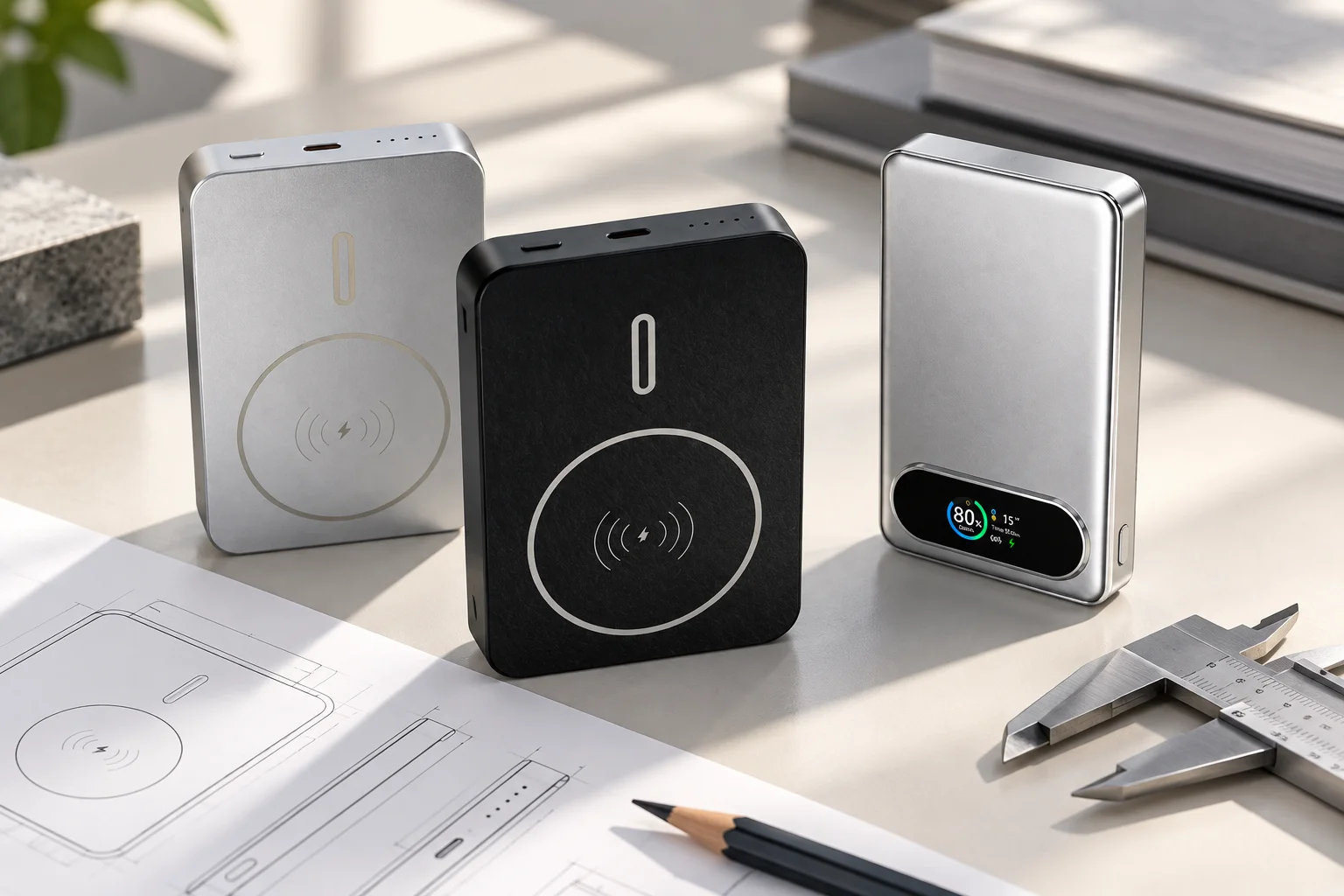
AI-generated product-selection illustration; not a measurement record or evidence that the pictured concepts share specifications.
5. Keep battery series and certification claims distinct
ZONNGOO presents all-solid-state, semi-solid-state lithium and lithium-polymer categories. Keep the exact category attached to the model reference throughout the comparison. A shared exterior or a similar model name does not make the internal configuration interchangeable. Ask for supporting information before making technical distinctions central to the retail message, especially if the shopper cannot independently see the difference.
Likewise, magnetic attachment, wireless charging power and certification are separate statements. The Wireless Power Consortium database identifies certified products and their WPC IDs. Verify the relevant identity when certification is claimed. Do not describe a magnetic ring or a compatibility phrase as proof of Qi or Apple certification. Battery-series wording should not become an absolute safety promise or a substitute for model-specific documentation.
6. Review the range side by side
Ask for suitable samples and evaluate the same customer questions for each candidate. Compare grip, pocket or bag convenience, display readability, connector access and the intended phone-and-case fit. Use ordinary operation within the instructions. A product that looks distinctive in a rendering may feel too similar to another option when a shopper handles both.
Record which features each sample actually represents. A visual mockup is not necessarily a final functional configuration, and a provisional package may not represent production printing. Keep open items visible rather than approving the range with a general statement that it looks good. The sample approval guide explains how to connect a reference sample to the specification and release record.
7. Limit variants before placing the first order
Count the operational effect of every added color, finish, battery variant and package language. Three base models can quickly become many separate stock references. For each variation, ask whether it serves a clear customer need and whether your team can identify, store and reorder it accurately. Do not assume the same commercial terms apply across all variants.
Request minimum order quantities, pricing, sample fees, replenishment timing and packaging requirements for the exact proposed mix. These are supplier-confirmed commercial inputs, not figures to invent from a general industry rule. If one variation remains uncertain, keep it outside the released order until the question is resolved. A controlled naming system helps prevent a reorder of a similar exterior with a different battery series or charging configuration.
8. Make packaging explain the differences
Give each item an accurate primary benefit, supported by a short set of comparable details. Keep model identification, battery-series reference where appropriate, connection information and relevant limitations easy to find. Use the same units and terminology across the range. A comparison becomes confusing when one package highlights cell capacity and another presents output capacity without explaining the basis.
Coordinate logo, product image, included accessories and instructions with the approved configuration. If packaging is localized, have the intended language reviewed rather than copying an English claim into every market. The packaging design page is a starting point for discussing the project. Confirm final artwork and fit separately; an attractive concept image does not establish an approved retail pack or shipping arrangement.
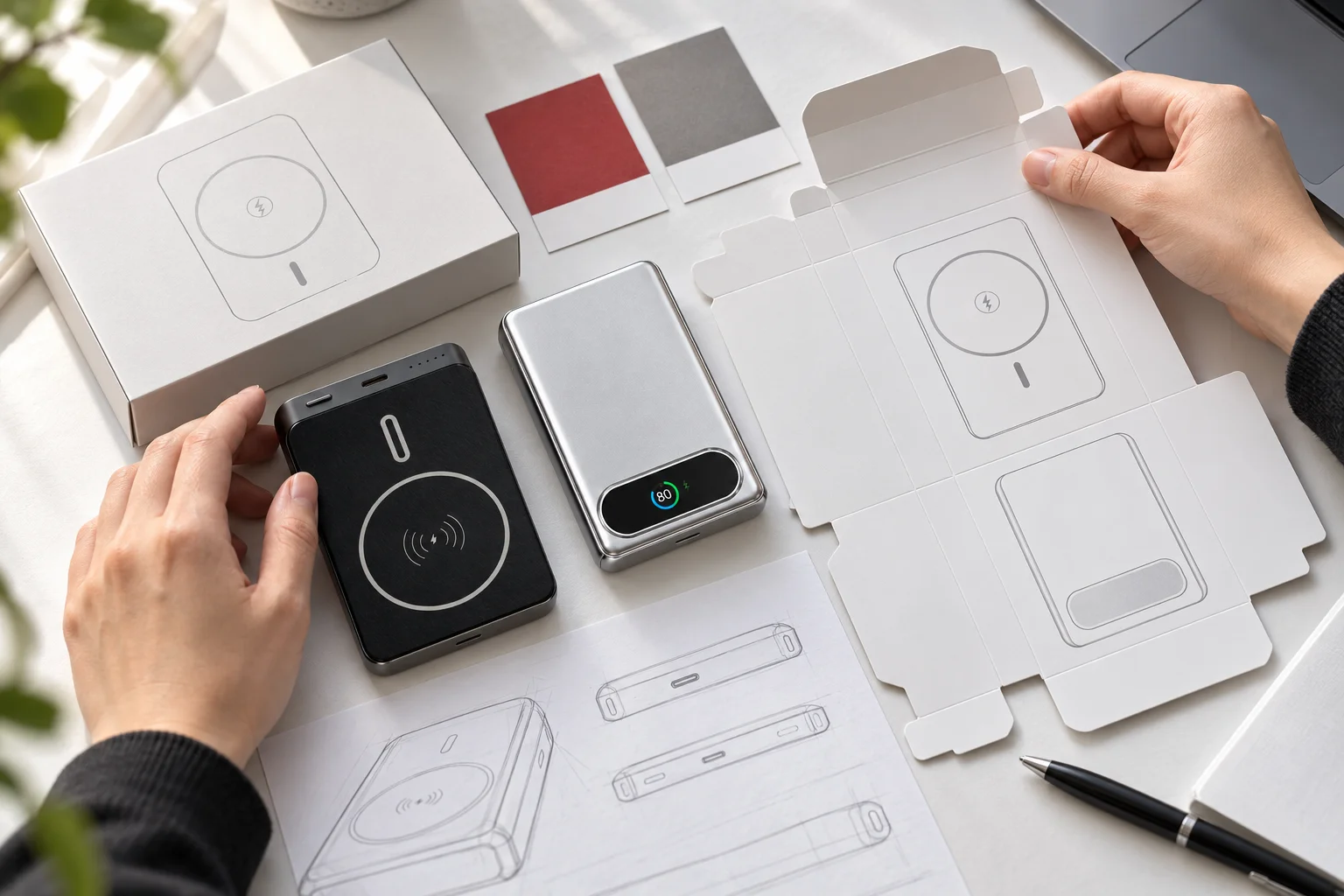
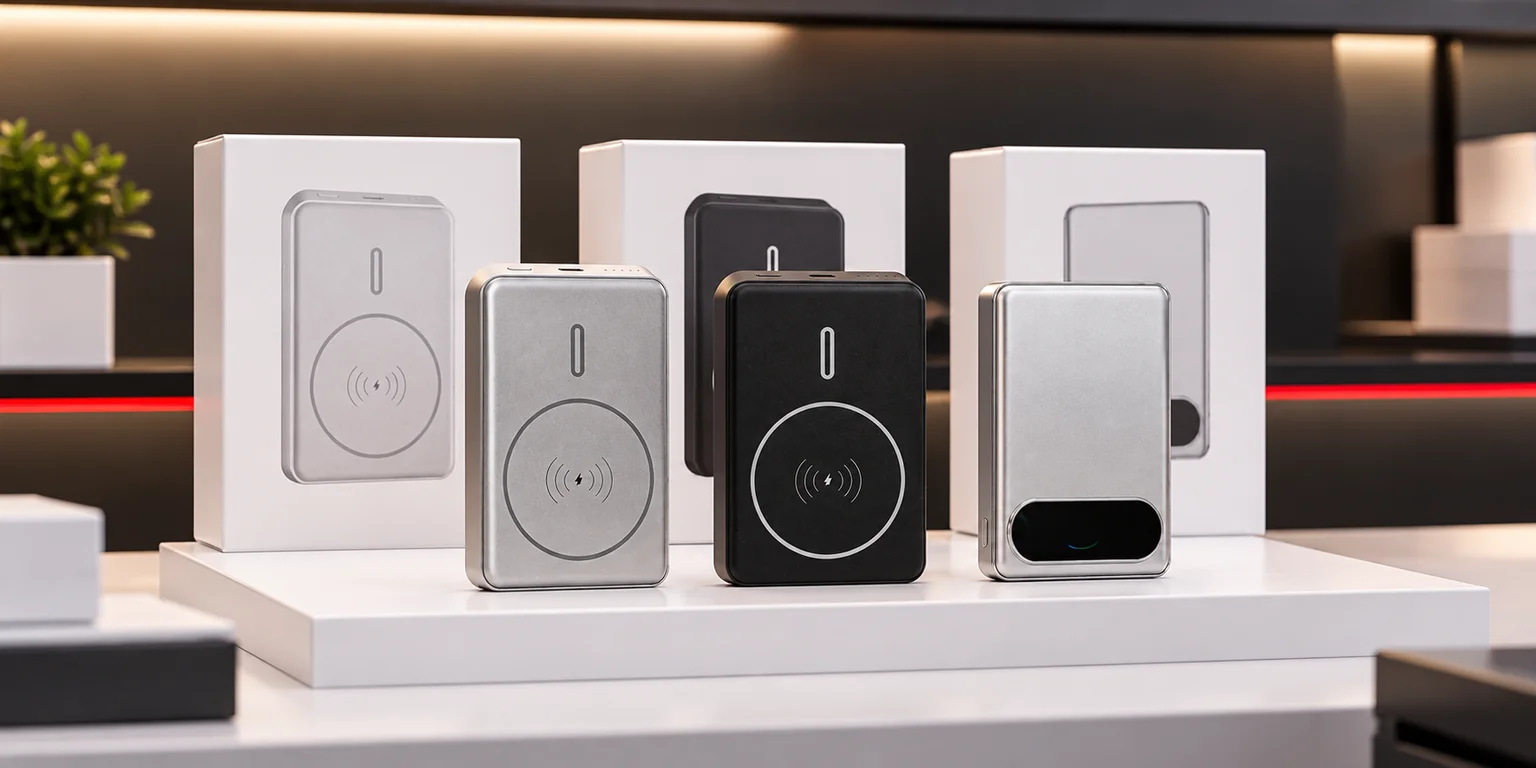
AI-generated packaging-review concept; not a photograph of a customer order, factory inspection or approved production artwork.
9. Prepare a simple comparison for staff and customers
Use a small table with the questions a customer actually asks: intended devices, connection method, carrying size, capacity basis and the main limitation. Link to the exact specification for details. Explain why each item exists without claiming one is universally best. A recommendation should follow the customer's use rather than the highest price or largest printed number.
Prepare answers to recurring compatibility questions. For magnetic options, the phone-case compatibility guide shows why attachment and charging need separate checks. For integrated cables, confirm connector assignments rather than assuming every cable provides every advertised function. Keep unconfirmed pairings out of a supported-device list, and do not label informal observations as laboratory tests.
10. Plan support and replenishment together
Before ordering, agree how your team will identify the product in a support enquiry: model, series, purchase reference and, where available, batch information. Define the supplier contact and the information needed to review a problem. Ask for applicable warranty terms and handling instructions rather than promising a duration or remedy that has not been agreed.
For replenishment, keep the approved specification, artwork revision and accessory list accessible. Confirm proposed substitutions before accepting a repeat order. Changes in packaging or electronics can affect customer information even when the product name stays similar. Inventory decisions should also consider the time required to receive and assess a revised sample. Reordering should reference an agreed configuration, not merely a photograph sent in an old conversation.
11. Use feedback to revise the assortment
After launch, collect the questions and reasons behind purchases, exchanges and support requests through your normal processes. Separate a compatibility misunderstanding from a functional issue or a preference about carrying size. Do not assume that an early sales pattern proves long-term demand, and do not treat a single positive comment as evidence of universal performance.
Use what you learn to decide whether to keep, replace or add a model. Review one meaningful change at a time where practical so the decision remains understandable. For a ZONNGOO range enquiry, send the channel, customer jobs, device list, destination market, proposed quantities and customization brief through the OEM/ODM page. Ask for candidate references and current terms; the supplier's response should define the next step, not an imagined sales forecast.
Frequently asked questions
Should a new retailer start with exactly three power banks?
No. Three is a framework for distinguishing customer jobs, not a rule. The right count depends on your channel, device needs, budget and ability to manage variants. Confirm that each proposed item has a clear role.
Is the largest capacity always the best premium option?
No. A premium position might reflect carrying comfort, interface convenience or a verified capability for the intended devices. Compare the complete product and capacity basis rather than equating the largest mAh with the best choice.
Can different battery series use the same retail description?
Only where every statement remains accurate for each exact configuration. Keep series and model references distinct and verify technical claims. Similar appearance does not justify transferring specifications or documentation between variants.
Should I launch every available color?
Not automatically. Each color adds a stock reference and may change minimum quantities or packaging needs. Start from a customer reason and supplier-confirmed terms rather than assuming more variation improves sales.
What should the comparison table include?
Use intended devices, connection arrangement, size or weight, capacity basis and key limitations. Keep units consistent and distinguish confirmed specifications from observations. Link to the exact model instead of making universal compatibility claims.
How can I discuss an opening range with ZONNGOO?
Email info@zonngoopower.com with your channel, target devices, customer priorities, market, proposed mix and quantities. Request current specifications, sample options and commercial terms for the selected battery-series references before approving the order.
Conclusion
A clear power bank range begins with different customer needs and ends with controlled product references. Compare capacity and charging on consistent terms, review samples together and make packaging explain the differences honestly. Limit variants to those your operation can support, then revise the range using real feedback. That approach creates a more understandable buying decision without relying on exaggerated specifications or unverified commercial promises.