
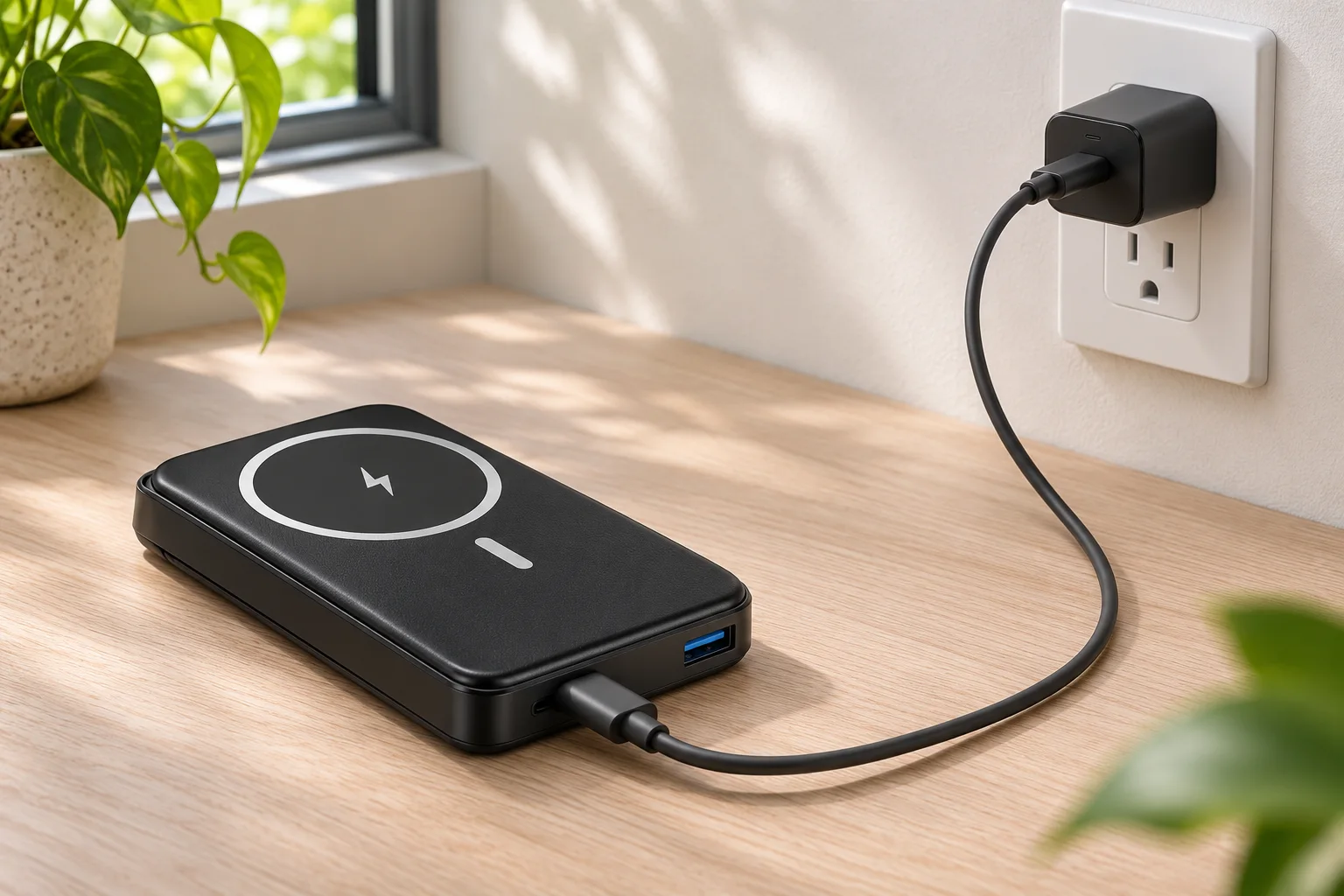
Quick Answer
Your power bank recharge time depends on its input capability, energy deficit, charging setup and charging control. Read the input specification, not the output headline. Divide energy to replace by charging power only for an ideal reference. Actual completion also involves losses, changing power and the manufacturer's completion criteria. Confirm the model's stated recharge conditions before buying accessories or advertising a refill time.
Introduction
You need a recharge-time estimate to plan tomorrow's use, choose an adapter or compare a supplier's samples. This guide separates useful arithmetic from actual performance. You will learn which specifications to read and which conditions to record before accepting a charging-time claim.
1. Read Input Separately From Output
You recharge the power bank through its supported input, which can differ from its advertised output.
Output describes energy delivered to your phone or another device. Input describes energy entering the power bank. A large output number does not establish an equally large input limit. Check the exact connector and direction in the specification table. Some connectors support both directions; others have a dedicated role.
The lithium-polymer 10C6 page illustrates why careful reading matters. Its output headline is 35W, while the USB-C input table prints a 20W maximum. However, that same input list includes 9V/3A, which arithmetically equals 27W. These printed entries need supplier clarification; do not silently resolve the inconsistency yourself.
Ask which input profiles and maximum apply to the current sample. Request a corrected specification before quoting recharge performance. Do not transfer an answer to the similarly named semi-solid-state version. You need the complete product reference, battery series and document revision together.
2. Find The Energy You Need To Replace
You estimate refill time from energy in watt-hours, not from a capacity number without its voltage basis.
Milliamp-hours describe charge quantity at a stated basis. Watt-hours describe energy. The conversion is capacity in amp-hours multiplied by the corresponding nominal voltage. For example, 10Ah multiplied by an assumed 3.7V equals 37Wh. This is an arithmetic example, not a confirmed energy specification for every 10,000mAh product.
Use the selected product's documented watt-hours when available. Otherwise, ask for the capacity basis and nominal voltage before calculating. Do not multiply an internal-cell mAh figure by a USB output voltage. Those figures describe different points in the system. Also distinguish cell capacity from rated output capacity and delivered energy.
You normally replace only the energy missing at the start. A displayed percentage is a useful operating reference, not necessarily a precise remaining-energy measurement. Therefore, calculations from an approximate percentage remain estimates. For product comparisons, agree the starting condition instead of assuming identical display readings guarantee identical energy deficits.
3. Use An Ideal-Time Calculation Carefully
You can divide energy to replace by assumed constant power to obtain an ideal reference time.
The units are straightforward: watt-hours divided by watts gives hours. Suppose a fictional battery needs 37Wh replaced. At an assumed constant 20W stored-energy rate, the arithmetic gives 1.85 hours. At 10W, it gives 3.7 hours. Neither result predicts a real product's complete recharge cycle.
Input-port power and stored-energy power are different measurement boundaries. If you use an input rating, conversion losses and device consumption also matter. Maximum input is not necessarily sustained throughout the cycle. Do not attach a universal efficiency multiplier or a fixed extra hour without supporting measurements.
| Calculation Element | What You Need | What It Cannot Prove |
|---|---|---|
| Energy deficit | Documented energy basis and starting condition | Exact energy from a rough display |
| Charging power | Defined measurement point and applicable setup | Continuous operation at the printed maximum |
| Ideal time | Energy divided by assumed constant power | Guaranteed complete recharge time |
| Actual elapsed time | Agreed start, finish and charging conditions | Identical results with different accessories |
Treat this calculation as a plausibility check. It helps you question unsupported claims without inventing a replacement performance promise.
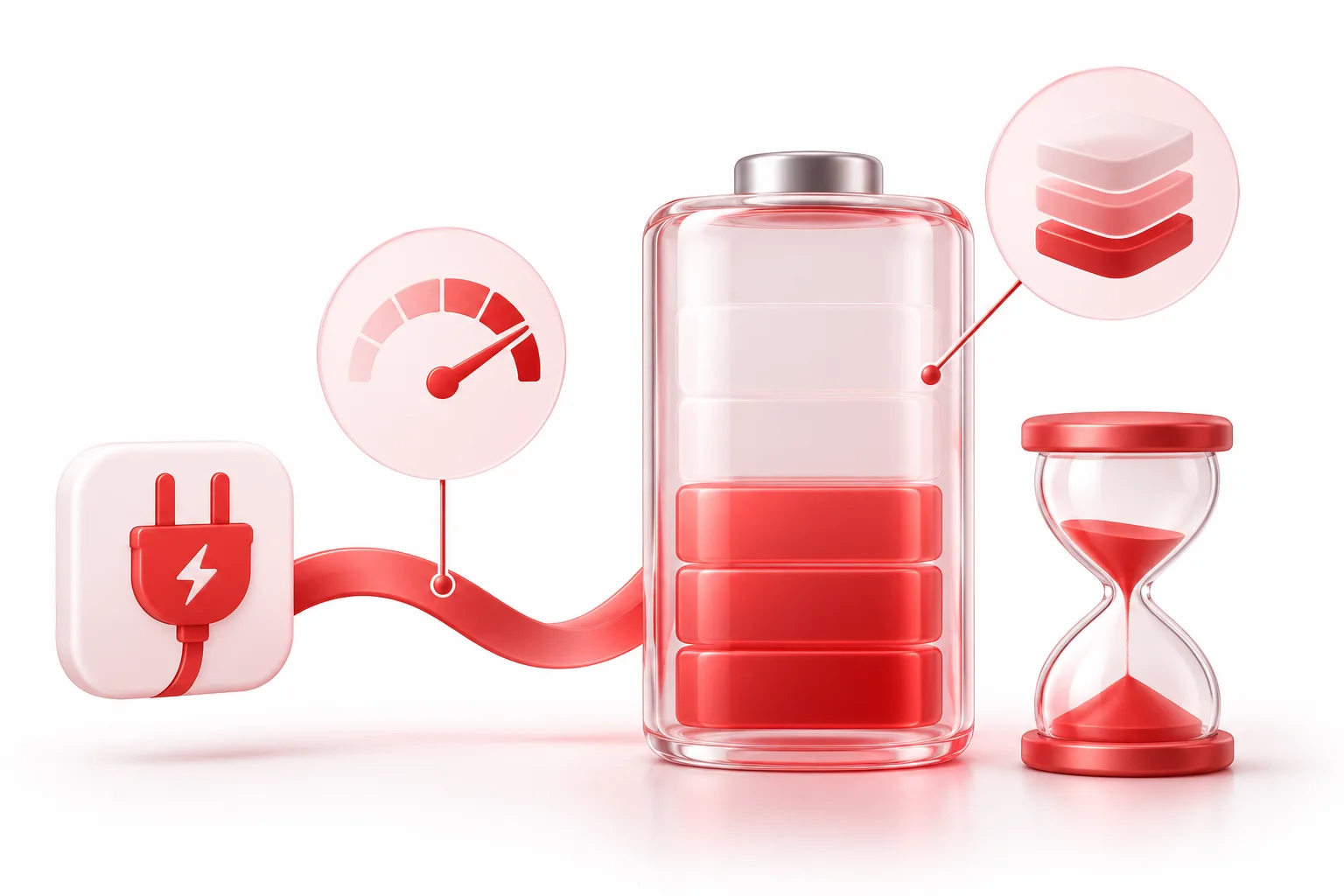
AI-generated conceptual illustration; not a measured charging curve, circuit diagram or product performance result.
4. Match The Adapter Profiles
You need a compatible adapter output profile, not merely a larger total wattage printed on its housing.
Compare the adapter's supported voltage and current with the power bank's confirmed input modes. Include the charging protocol, not just the connector shape. A higher-rated adapter cannot make a receiving product exceed its supported charging behavior. Conversely, an unsuitable profile can prevent the expected mode from being available.
USB-IF's Power Delivery overview explains flexible power delivery and devices taking the power they require. That describes the technology; it does not certify your particular adapter, cable or power bank. Verify the selected combination rather than borrowing the standard's maximum capabilities for a product description.
For a multiport adapter, ask what happens when another port is occupied. The headline total may differ from the allocation to your chosen port. Keep other ports unused during a single-device comparison unless your agreed procedure says otherwise. If daily use includes other devices, review that arrangement separately.
5. Check The Cable And Input Connector
You should verify the cable and charging connector before blaming the battery for slow recharging.
Match the cable type, current capability and applicable charging mode to the confirmed input requirements. A USB-C shape alone does not document every electrical capability. Avoid relying on an unlabelled cable's appearance as evidence. Use the supplied or otherwise specified accessory when evaluating the manufacturer's recharge claim.
Built-in cables need separate attention. A convenient integrated connector may have a different role or limit from a detachable port. Confirm whether the proposed input route supports recharging and which specification applies. The built-in cable buying guide explains why connector roles must be checked individually.
Inspect connectors and cables without opening the product. Do not use visible damage as an opportunity for repeated performance trials. Replace an unsuitable accessory with an appropriate known reference, following the product instructions. Record the change so your comparison remains understandable. Changing several accessories together hides which difference affected the result.
6. Allow For Charging Taper
You should not assume the last part of charging progresses at the same rate as the middle.
Lithium-ion charging commonly includes current-controlled and voltage-controlled stages. Analog Devices' charging explanation describes current falling during voltage regulation. This explains why constant-power arithmetic cannot describe an entire cycle. It does not identify the controller or charging curve inside a particular ZONNGOO model.
The Texas Instruments charging application note also distinguishes charging stages. Its example parameters are not consumer settings for your power bank. Do not copy cell-voltage thresholds, stage percentages or termination values into product instructions. Follow the complete product's specified operation.
For a comparison, define whether completion means a displayed percentage or the manufacturer's charge-complete indication. Keep that definition consistent between runs. A quick rise through the middle does not establish the remaining time. Likewise, a slower final segment does not by itself prove a faulty product.
7. Keep The Charging Environment Suitable
You need suitable operating conditions before a recharge-time comparison can mean anything.
Follow the model's charging instructions and environmental limits. Use an appropriate surface and keep the setup unobstructed as instructed. Do not cover the product or use bedding as a charging surface. If the unit appears damaged or behaves abnormally, stop ordinary use and seek appropriate support.
Charging control and allowable current depend on the battery and product design. An unfamiliar environment should not become an excuse to bypass protection. Never heat, chill or modify a power bank to force a preferred result. You are evaluating normal permitted use, not attempting to defeat its operating controls.
Record the environment when comparing samples or investigating a changed result. Compare under consistent, permitted conditions instead of mixing an outdoor afternoon with an indoor morning. Ask the supplier about an unexpected difference. You cannot establish a universal temperature correction or a fixed recharge-time penalty from one observation.
8. Separate Recharging From Powering Other Devices
You should evaluate recharging alone before introducing simultaneous output loads.
Disconnect phones and other accessories for a standalone refill comparison, following the instructions. A connected device can change the operating situation even when its screen is dark. Do not treat its presence as irrelevant simply because you are watching only the power bank's indicator.
Simultaneous input and output requires explicit product support. Do not assume pass-through operation from the number of connectors. Ask about supported combinations, allocation and instructions before using that mode. A standalone recharge-time claim does not automatically describe the same product while it powers another device.
For procurement, define the intended use case first. A customer topping up a phone while refilling the bank has a different question from a retailer comparing empty samples. Keep those results in separate records. If combined operation matters commercially, request evidence for that precise arrangement instead of extending a simpler claim.
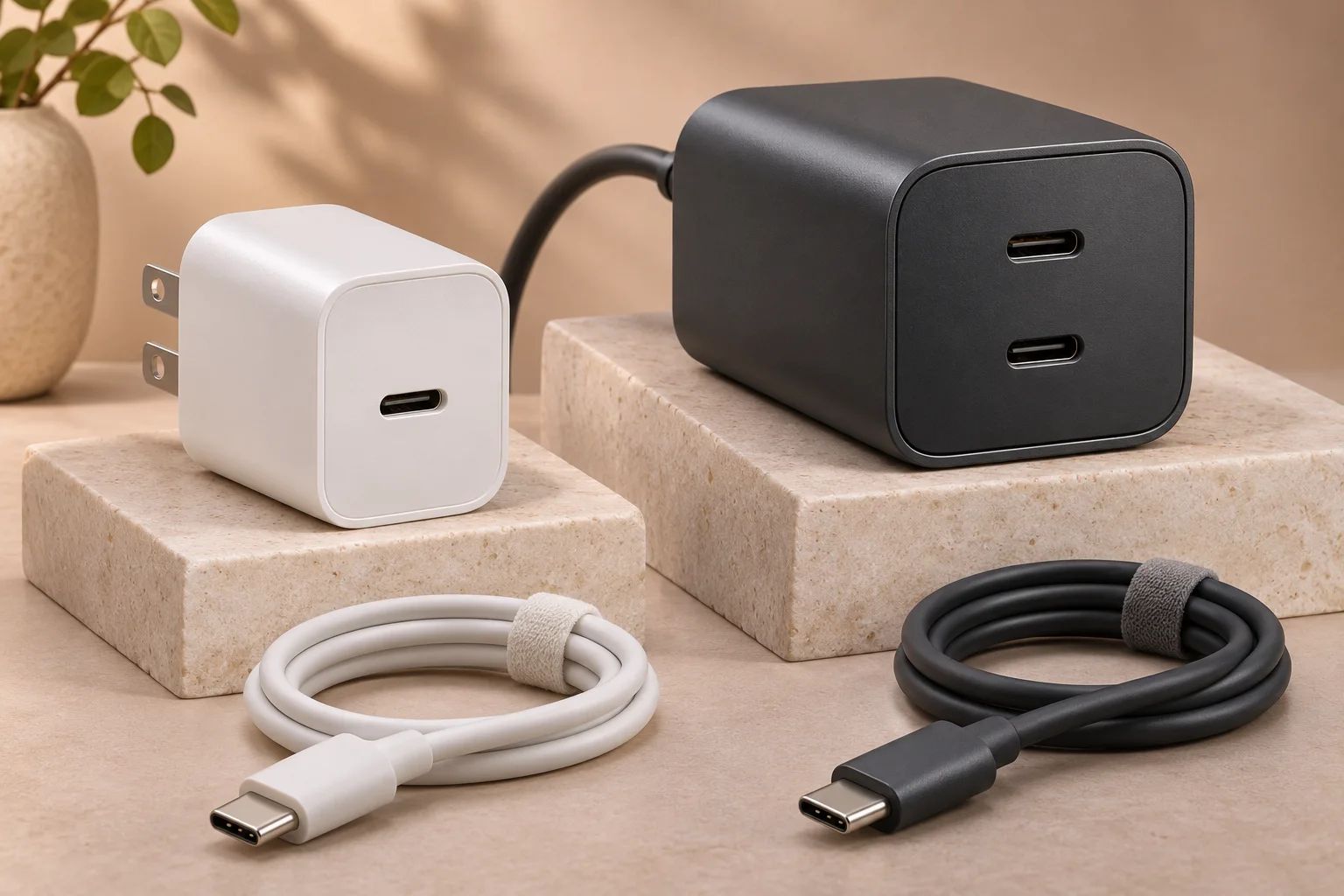
AI-generated accessory comparison; not actual adapter ratings, compatibility testing or a supplied bundle.
9. Record A Repeatable Recharge Comparison
You need matching conditions and a clear endpoint to compare elapsed recharge times fairly.
Start with the exact model, series and sample identification. Record the starting indication without deliberately forcing an unsafe or prohibited discharge. Use the specified preparation method if the supplier provides one. Then identify the adapter, its chosen port and the cable used.
Write down connection time, completion time and the meaning of completion. Note interruptions, accessory changes and connected loads. Keep observations separate from explanations: a longer result is an observation, not immediate proof of a defective cell. A display photograph alone does not document the entire charging path.
For commercial claims, request the supplier's measurement method and supporting record. Agree what variation or acceptance criterion your project requires. Repeatability cannot be established from one attractive demonstration. The sample approval guide links observations to the approved configuration. This article does not report ZONNGOO laboratory testing.
10. Troubleshoot One Variable At A Time
You can investigate unexpectedly slow charging by checking the documented setup before making a fault diagnosis.
First, confirm that you are using an input-capable connector. Next, compare the adapter profile with the model's confirmed requirements. Check whether another adapter port is sharing power. Then review the cable and any interruption in the charging session.
If the product is undamaged, use an appropriate reference accessory as directed and record the new result. Do not change adapter, cable, port and starting condition together. That produces a different session without revealing the cause. Avoid inferring current or energy from an animated indicator alone.
Stop experimentation when there are damage signs or concerning behavior. For ordinary support, send the model reference, setup details and observed timeline. Describe whether charging is slow throughout or mainly near completion. Do not open the housing, probe internal cells or improvise a higher-voltage source. Leave diagnosis and corrective instructions to the appropriate support process.
11. Ask ZONNGOO For A Defined Recharge Claim
You should request recharge evidence tied to the exact configuration before printing a time on your packaging.
ZONNGOO's catalog separates battery families and model variants. Its ODM/OEM page and sample confirmation page provide relevant project discussion routes. Request current input specifications, applicable instructions and the proposed sample configuration. Do not infer a verified recharge time, certification or adapter bundle from those service descriptions.
Include your destination market, quantity, intended adapter and cable arrangement, and desired starting and finishing conditions. Ask whether any quoted time is measured, estimated or conditional. Clarify whether the claim includes a supplied accessory or assumes a separately purchased one. Keep unresolved specification conflicts visible until corrected.
For branded products, carry the approved conditions into your packaging design brief. Accessory selection, documentation and evaluation scope affect the project; they do not justify invented unit prices or deadlines. Send one complete requirement set through the inquiry link so the supplier can answer the actual use case.
Frequently Asked Questions
Does A 65W Charger Always Refill A Power Bank Faster?
No. You need compatible input profiles, an appropriate cable and a receiving product that can use the available mode. Extra adapter capability does not remove the power bank's limits. Compare the confirmed setup rather than the adapter's largest printed number.
Can I Calculate Recharge Time From 10,000mAh Alone?
No. You also need the energy basis, starting condition and applicable charging power. Converting mAh requires the corresponding nominal voltage. Even correct energy arithmetic remains an ideal reference rather than a complete charging-time prediction.
Why Does Charging Slow Near The End?
Charging control can reduce current as the battery approaches completion. The exact behavior depends on the model. Compare against its instructions and completion definition. A slower final portion alone does not establish a fault or a universal remaining-time percentage.
Can I Use Output Wattage As The Recharge Rating?
No. You must read the input specification for the chosen connector. Output and input describe different directions. If the input table contradicts itself, request clarification before choosing accessories or publishing a recharge claim.
Should I Empty The Power Bank Before Every Recharge?
Do not create a full-discharge routine just to reproduce a calculation. Follow the manufacturer's normal use and evaluation instructions. Use an agreed starting condition for comparison, and never bypass protection or force discharge to an internal-cell threshold.
What Should I Send With A Slow-Charging Enquiry?
Send the complete model and series, adapter profiles, chosen port, cable details and starting indication. Add elapsed time, completion behavior, connected loads and relevant conditions. These details support a useful review without pretending that one symptom proves the cause.
Conclusion
Your useful recharge estimate starts with confirmed input and energy information. Keep ideal arithmetic separate from measured completion time. Compare consistent conditions and resolve conflicting specifications first. For a branded claim, request evidence for the approved model, accessories and endpoint before publishing it.