Quick Answer
You can use a power bank while it is charging only when its manufacturer supports that exact input-and-output arrangement. This feature is often called pass-through charging. Check the permitted ports, adapter, output limits and connection transitions. A USB-C input/output label alone does not prove support, and pass-through does not automatically mean uninterrupted backup power.
Introduction
Pass-through charging can simplify a charging setup, but you need more than two connected cables. This guide explains what to confirm, why the battery may refill slowly and how to evaluate connection changes. It also helps you write an evidence-based requirement before ordering a branded product.
1. Define Pass-Through Charging Precisely
Pass-through charging means a supported operating arrangement accepts external power while supplying a connected device through an approved output.
The phrase does not describe one universal circuit or priority rule. One implementation may prioritize the connected device. Another may restrict available output or pause battery charging under certain conditions. Ask what the supplier actually means instead of assuming identical behavior across products.
Also separate connection from useful operation. An input cable can be attached without providing the expected power. A phone can show a charging symbol while the power bank’s battery makes little progress. Record the input source, output device and battery state separately when assessing the arrangement.
Your practical question is specific: can this model support this adapter, these cables and this load together? State whether you need the internal battery to gain charge during use. If you also need continuity during an outage, define that separately. A broad yes-or-no answer about pass-through can conceal several different requirements.
2. Do Not Infer Support From USB-C Labels
A port marked input/output can serve different power roles without proving simultaneous operation through other ports.
The USB Implementers Forum distinguishes source, sink and dual-role power behavior in its USB-C overview. A dual-role port can act as a source or sink. This role description does not certify a complete product’s pass-through arrangement.
Identify the actual input connection and a separate supported output path. Never connect an output back into the same power bank. Do not add splitters or improvised adapters to force simultaneous operation. Use the connection arrangement documented for the product rather than judging by the number of sockets.
Built-in cables also need individual verification. A cable used for output may not accept input, even when another socket does. If your setup includes wireless charging, request confirmation for that exact combination too. The built-in-cable selection guide helps you distinguish cable roles before selecting the complete arrangement.
3. Ask How Power Is Allocated
You need the model’s documented priority rules to know whether external input supports the device, battery charging or both.
Texas Instruments’ BQ25895 documentation illustrates power-path management at component level. Its system-management functions distinguish supplying a system from charging a battery. That distinction explains why separate power paths matter. It does not establish the chip or operating behavior of any ZONNGOO product.
For your finished product, request a description of input priority and battery behavior. Ask what happens when the connected device’s demand changes. Does battery charging reduce, pause or resume under documented conditions? Can stored energy decline while external input remains connected? These questions need model-specific answers.
Keep the explanation tied to the user’s task. A desk phone charger and a travel charging bundle may need different outcomes. If your goal is leaving with a refilled power bank, continuing phone charging is insufficient evidence. You need confirmation that the internal battery also gains the required energy within your available time.
4. Use A Power Budget Instead Of Adding Labels
You should compare actual available input with connected demand and system losses before expecting the battery to refill quickly.
For a fictional calculation, assume 20W enters the complete setup, 12W reaches the connected device and 2W covers losses. That leaves 6W for the remaining energy balance. These invented values illustrate arithmetic only. They are not typical efficiency, a product specification or a measured charging result.
You cannot substitute adapter nameplate power for measured or confirmed accepted input. Nor should you subtract output maxima that never occur together. Keep the measurement boundaries consistent. Ask for the permitted combination and the conditions attached to any quoted input, output or battery-charging value.
A battery percentage changing slowly does not by itself identify the limiting factor. Input negotiation, operating limits and device demand require separate checks. Compare the same product charging alone under its instructions. The power-bank recharge-time guide explains why capacity divided by a headline input wattage is only an incomplete estimate.
5. Match The Adapter And Both Cables
You should approve the complete input-and-output chain, including adapter profiles and the two cable paths.
List the wall adapter’s supported outputs and the power bank’s accepted input. Then list the receiving device’s requirements and the power bank’s supported output in this mode. Confirm the overlap rather than selecting solely by the largest number printed on either product.
Include both cable types, lengths and supplied versions in the review. A good output cable cannot compensate for an unsuitable input path. Keep connectors accessible and avoid strain when positioning the equipment. Follow the manufacturers’ normal placement and operating instructions throughout the arrangement.
If you include an adapter in a branded bundle, identify its exact version in the quotation and sample record. Do not approve one adapter and silently substitute another based only on matching wattage. Protocol support and port allocation also need confirmation. For a simpler mains-powered setup, consider a compatible charger connected directly to the receiving device.
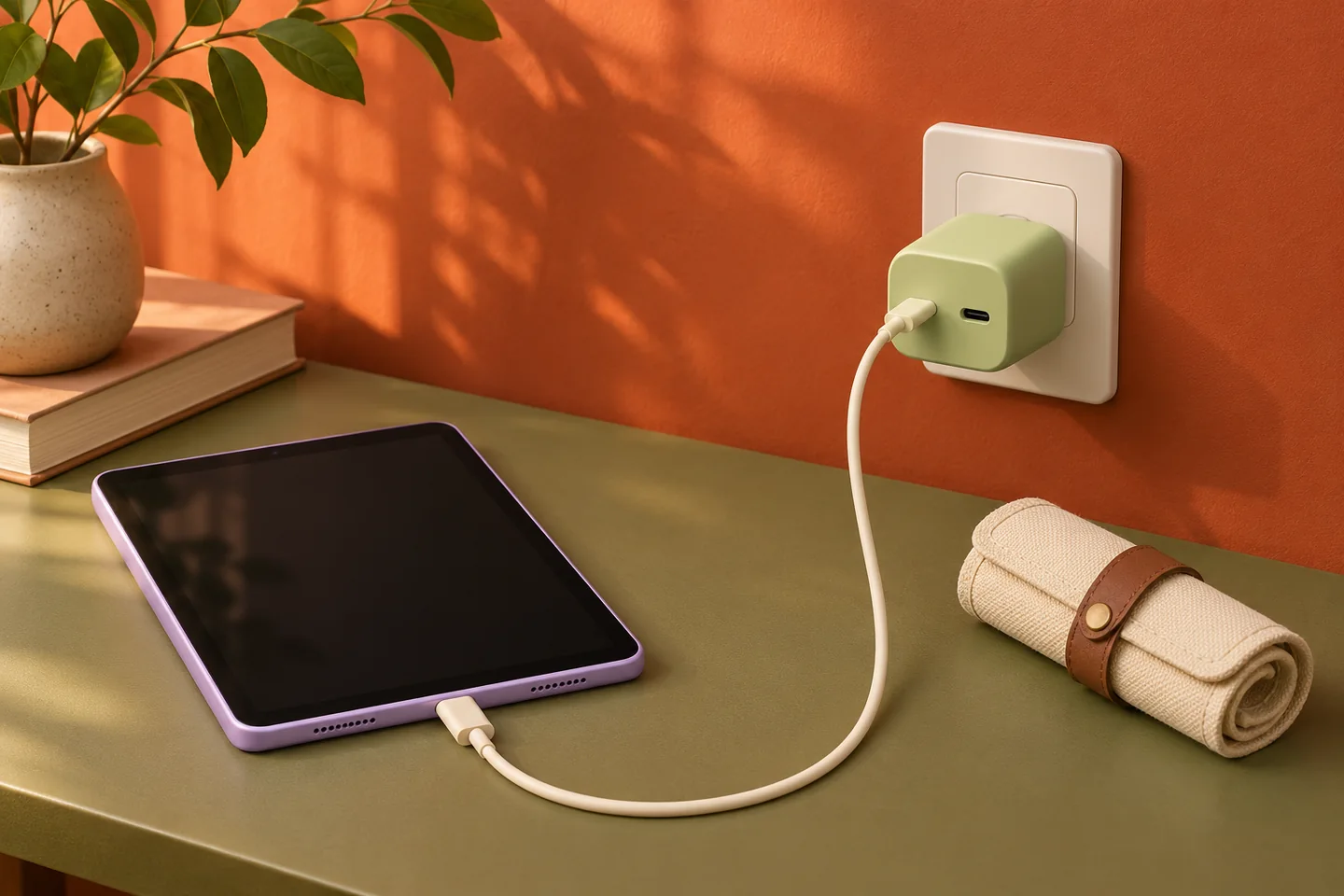
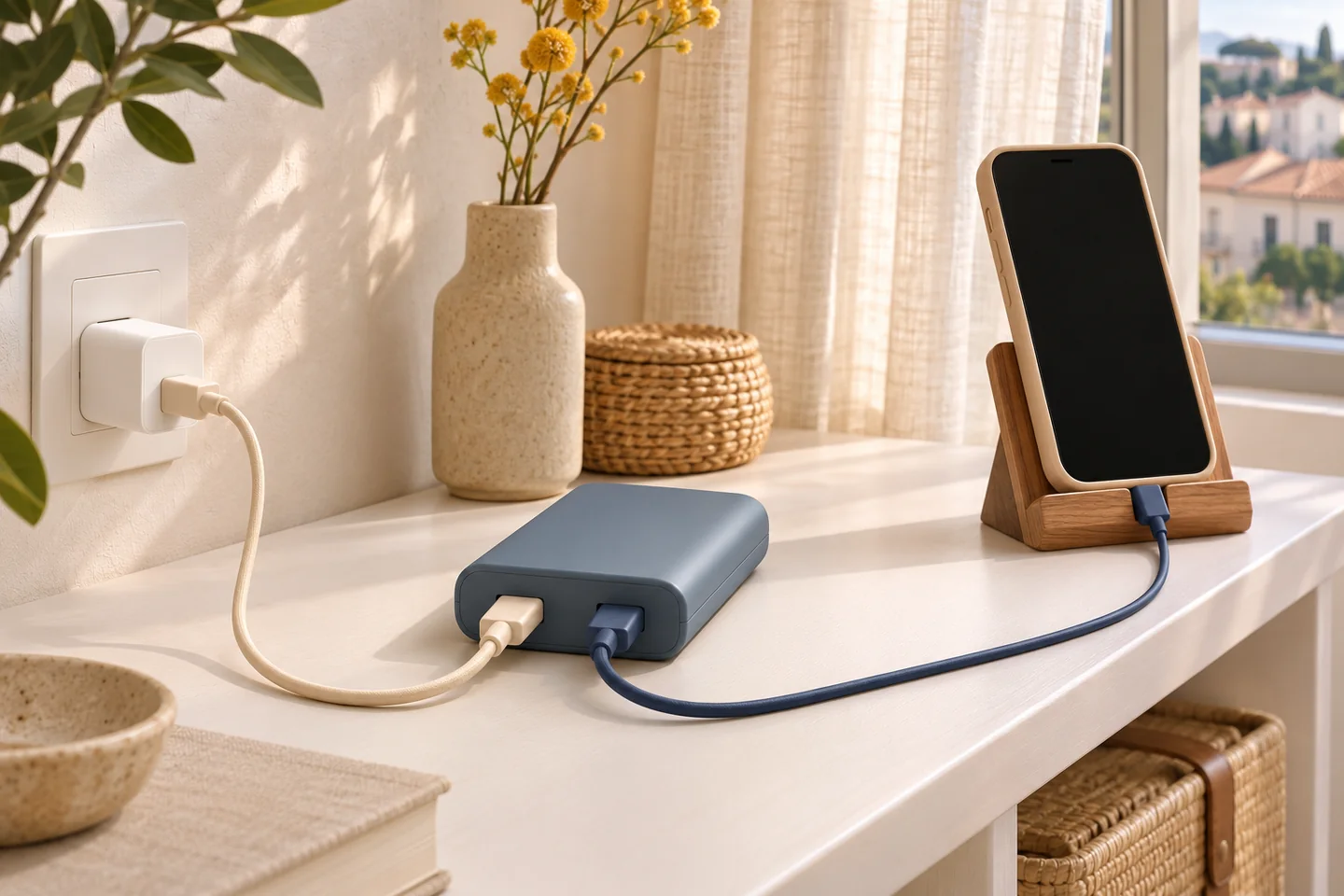
AI-generated direct-charging concept; not an exact product photograph, compatibility test or actual customer installation.
6. Compare The Outcomes You Actually Need
You should choose an arrangement by required behavior rather than treating every connected charging setup as equivalent.
| Requirement | What To Confirm | What Does Not Prove It |
|---|---|---|
| Charge the power bank alone | Approved input source and recharge conditions | Output wattage headline |
| Charge a device while input is connected | Supported pass-through ports and limits | Two cables fitting physically |
| Refill the battery during device use | Net battery progress under the intended load | Phone charging symbol |
| Charge two receiving devices | Combined-output rules for that arrangement | Individual port maxima added together |
| Continue through input disconnection | Documented transition and device compatibility | Pass-through label alone |
| Operate as an uninterrupted backup | Appropriate documented backup capability and qualification | A short charging demonstration |
Use the table to separate purchasing requirements. Several can apply to one project, but each needs its own evidence. For shared outputs, consult the two-device charging guide. Its combination checks do not independently establish simultaneous input support. Record exactly which operating arrangement your supplier confirms.
7. Check Connection And Disconnection Transitions
You should verify what the receiving device experiences when external input connects, disconnects or returns.
Start by asking whether output pauses or renegotiates during each transition. Request documented behavior rather than an unsupported promise of instant switching. A phone may tolerate a change that another device does not. Specify the receiving device and its intended function instead of assuming universal tolerance.
Connection order belongs in the sample procedure. Record whether input was attached before or after the output device. Observe any required button action and whether charging resumes automatically. Also note the power bank’s starting state. Repeat only supported arrangements; do not deliberately create electrical faults to provoke a response.
Treat any observed continuity as specific to the checked conditions. A brief demonstration does not establish outage protection across every load and battery state. If uninterrupted operation is essential, select equipment documented for that requirement. Do not use an ordinary pass-through claim as evidence for medical, emergency or other continuity-critical equipment.
8. Keep Operating Limits And Heat Claims Separate
You should follow the product’s documented operating conditions without assuming simultaneous input and output has identical limits to either alone.
Ask whether supported load, placement or ambient conditions change in pass-through mode. Obtain any relevant derating or duration instructions. Do not invent a universal temperature threshold from an online anecdote. A component datasheet’s thermal figures also cannot serve as the finished enclosure’s permitted user conditions.
Avoid both blanket reassurance and unsupported alarm. This guide does not establish that every supported arrangement damages a battery. It also cannot promise unchanged lifetime, temperature or efficiency. Those claims require evidence for the exact hardware, firmware, environment and usage pattern. Do not turn an attractive demonstration into a battery-longevity guarantee.
If you observe damage or abnormal behavior, stop use and follow the manufacturer’s support instructions. Do not cover equipment or modify it to continue an unsupported arrangement. If you only need charging near an outlet, a direct compatible charger may meet the task with fewer configuration questions.
9. Do Not Confuse Pass-Through With A UPS
Pass-through support does not by itself establish an uninterruptible power supply or a guaranteed transfer time.
A backup requirement concerns the load’s continuity, not merely the presence of a battery. You need documented output behavior when the input disappears and returns. Specify acceptable interruption, supported power and duration with the responsible equipment provider. Do not infer these from a USB connector or a capacity number.
Also identify whether the receiving device requires a specific voltage, startup behavior or communication exchange. A setup that begins charging after reconnection may still fail a continuity requirement. Record the task’s actual consequence if power pauses. That determines whether an ordinary charging convenience feature is even relevant.
For a continuity-dependent application, ask for appropriately qualified equipment and supporting documentation before deployment. This article provides purchasing questions, not backup-system qualification. Avoid advertising router, security or emergency backup from an unverified charging setup. Match the product category to the real requirement rather than stretching a pass-through description beyond its evidence.
10. Define A Model-Specific Sample Approval
You should approve a written input-and-output configuration, not a general statement that the sample can charge both ways.
Record model, hardware or firmware version where available, adapter, cables, receiving device and starting battery state. Define the expected output behavior and required battery progress. Include input connection, removal and return observations if those actions matter. Agree the observation method and acceptance conditions before reviewing samples.
Use photographs to document the arrangement, not to claim continuous delivery or internal battery performance. Where measurements are required, agree appropriate instruments and a technical method with the responsible team. Keep actual results separate from proposed criteria. A checklist written before evaluation is not evidence that the product passed it.
The sample-confirmation page can frame this discussion. Preserve the approved configuration with the order and packaging revision. If an adapter, cable or internal version changes, ask whether re-evaluation is necessary. Do not assume an unchanged housing proves unchanged pass-through behavior.
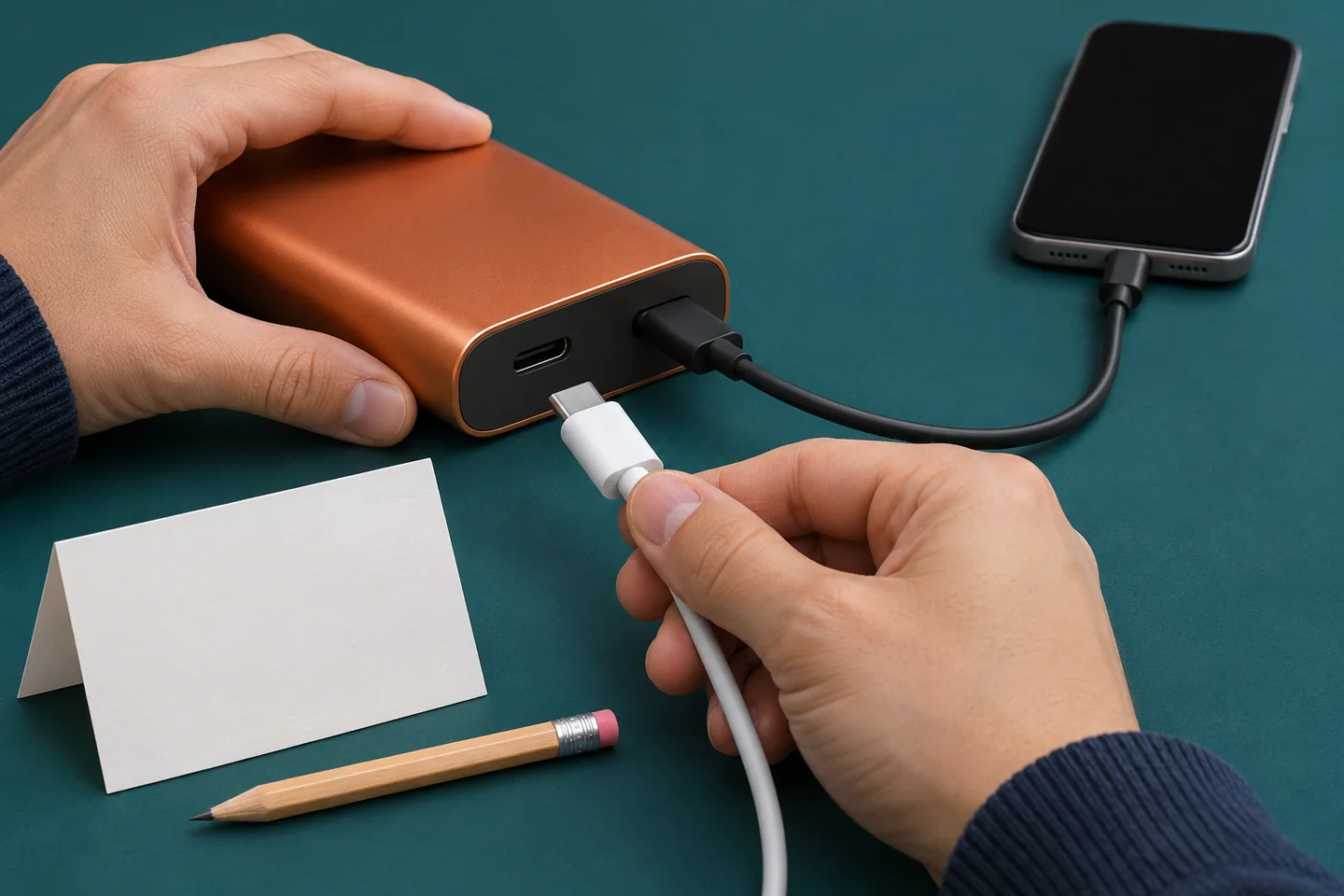
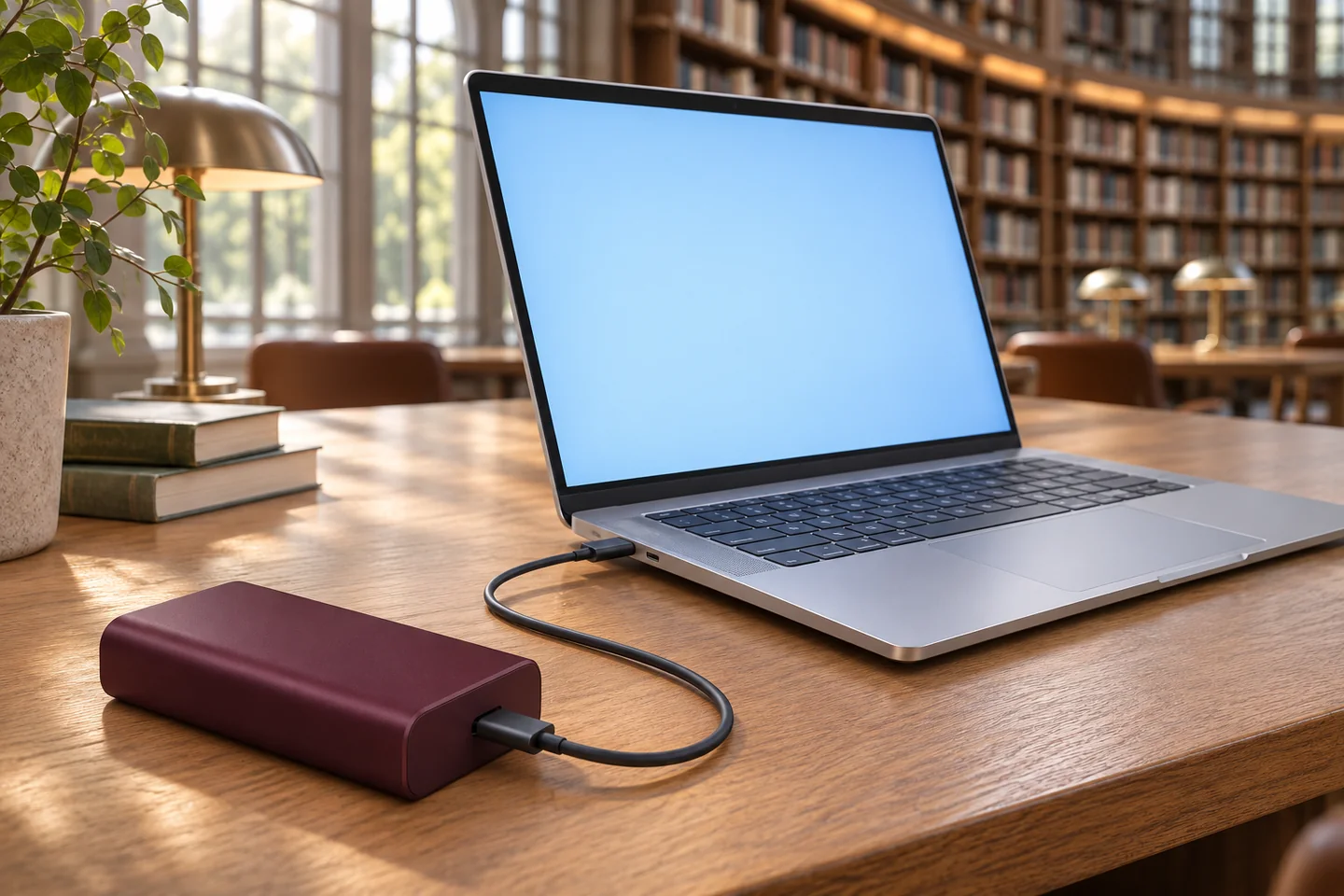
AI-generated connection-order planning concept; not a real inspection, measured switching test or proof of uninterrupted output.
11. Turn The Requirement Into An Honest Product Brief
Your product brief should name the supported arrangement and its limits before making a pass-through claim.
Start with the ZONNGOO product categories, then request the current manual and exact configuration. All-solid-state, semi-solid-state and lithium-polymer families do not independently establish this feature. Neither do magnetic charging or a digital screen. This article confirms no specific ZONNGOO model’s pass-through support.
For a branded project, discuss your intended arrangement through OEM/ODM planning. Ask which available configurations can be evaluated. Any development request needs separate feasibility, schedule and approval scope. Packaging instructions should match confirmed ports, compatible inputs, transition behavior and applicable limitations in every sales language.
Send one consolidated requirement through Contact Us: adapter, cables, receiving devices, required battery progress, continuity needs, market and quantity. Request a model-specific answer and proposed sample procedure. That gives you an actionable comparison without treating an undocumented charging convenience as a universal feature or backup guarantee.
Frequently Asked Questions
These answers distinguish general charging concepts from features that require confirmation for your exact model.
Can Every Power Bank Charge A Phone While Recharging?
No. Confirm the manufacturer’s supported input-and-output arrangement. Multiple sockets or an input/output label do not prove pass-through operation. Use the documented configuration and limits.
Why Is The Power Bank Percentage Not Increasing?
The connected device and system operation may leave little available power for battery charging. That is one possible explanation. Check accepted input, supported mode and actual battery progress rather than diagnosing from the display alone.
Does A Stronger Adapter Guarantee Faster Pass-Through Charging?
No. The power bank must accept a compatible profile and support the required operating arrangement. Cable and mode limits still apply. Nameplate power alone cannot establish the result.
Is Pass-Through The Same As Charging Two Devices?
No. Two-device charging concerns multiple receiving loads. Pass-through also involves external input into the power bank. Verify each combination separately when your intended use needs both.
Can I Use It As An Uninterrupted Backup?
Do not infer that from pass-through support. You need documented transition behavior and appropriate backup qualification for the receiving equipment. An ordinary charging demonstration cannot establish those requirements.
What Should I Ask ZONNGOO Before Ordering?
Provide the full connection chain, desired output, battery-refill requirement and any continuity requirement. Include market and quantity. Request current documentation and a defined sample evaluation before approving a claim.
Conclusion
Use a power bank while charging only through a manufacturer-supported arrangement. Confirm ports, input compatibility, power allocation and transitions. Define battery-refill and backup needs separately. Before ordering, request evidence for the exact configuration and keep customer instructions within its documented limits.